

Trifluridine (brand name Viroptic) is a topical antiviral eye drop used to treat epithelial herpes simplex virus (HSV) keratitis - the dendritic and geographic ulcers that develop on the corneal surface during active herpes infection. It is one of two main agents used for this purpose; the other is ganciclovir gel (Zirgan). Trifluridine has been a workhorse topical antiviral in the United States for decades, although many practices now favor ganciclovir gel because of its less frequent dosing and better corneal tolerance.
Key takeaways
- Used for active epithelial HSV keratitis - dendritic and geographic ulcers; not for stromal disease alone
- Dosed every 2 hours while awake during active infection, up to a maximum of 9 drops per day
- Most cases resolve in 7-14 days with adherent treatment
- Toxicity to the corneal surface with prolonged use; reassess if no improvement after 7 days or no full re-epithelialization by 14 days, and avoid continuous use beyond 21 days
- Not effective against established stromal keratitis or uveitis alone - those forms typically need oral antivirals plus topical steroids under careful supervision
Questions about your diagnosis? Contact our office
Visual guide: Trifluridine: treatment needs rechecks
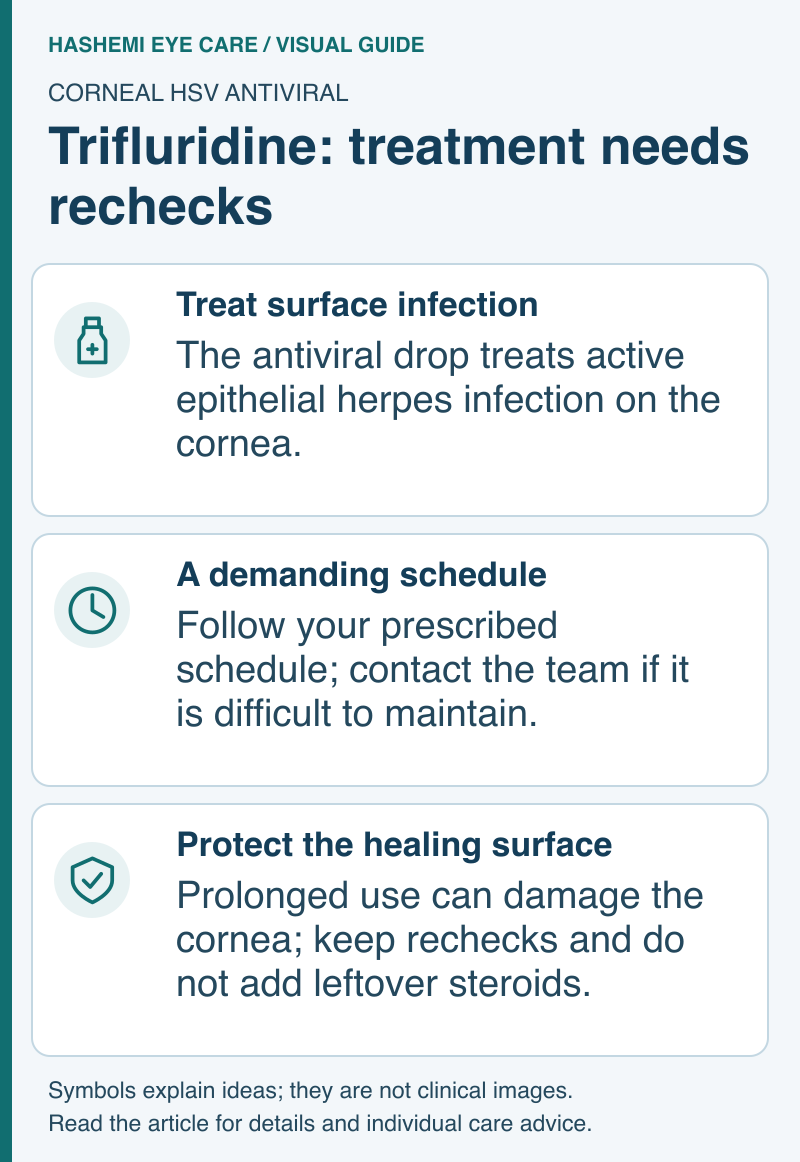
Read this visual as text
How It Works
Trifluridine is a thymidine analog that, after intracellular phosphorylation, becomes incorporated into viral DNA, halting replication. Unlike acyclovir-family agents, its activity is not dependent on viral thymidine kinase, so it can retain activity against some thymidine-kinase-deficient resistant strains.
The drug is rapidly cleared from the tear film, which is why frequent dosing is required to maintain therapeutic concentrations on the corneal surface.
Common Uses
- Epithelial HSV keratitis - dendritic and geographic ulcers; the primary indication
- Reactivation episodes - used during each acute attack
- Adjunctive use during long-term management of recurrent disease (with oral antivirals as the maintenance therapy)
Not Indicated For
- Stromal keratitis - disease in the deeper cornea is treated with oral acyclovir family agents and carefully managed topical steroids; topical trifluridine alone is inadequate
- HSV uveitis or retinitis - systemic treatment is required
- Prophylaxis after corneal transplant in HSV history - oral antivirals are standard
How to Use
- Active infection dosing: One drop in the affected eye(s) every 2 hours while awake, up to a maximum of 9 drops per day, until the ulcer reepithelializes - usually 7-14 days
- After confirmed healing: One drop every 4 hours while awake, with a minimum of 5 drops per day, for an additional 7 days as directed
- Duration guardrails: reassess if no improvement after 7 days or no full re-epithelialization by 14 days; continuous use beyond 21 days should be avoided due to corneal toxicity
- Storage: Keep refrigerated, 2-8°C (36-46°F), per the Viroptic label
- Multiple drops: Wait at least 5 minutes between different eye drops
- Contact lenses: Do not wear during treatment
What to Expect
Symptom Improvement
- Pain and photophobia begin to improve within 2-4 days
- The dendritic ulcer fades over 5-10 days
- Reepithelialization (full healing of the surface) over 7-14 days
- Vision improves with healing, though some patients have residual subepithelial haze or scarring
Demanding Schedule
- The every-2-hour-while-awake dosing is demanding and requires patient commitment
- Set alarms; carry the bottle
- Contact the prescribing team if the schedule is difficult; do not increase the dose or continue beyond the prescribed course
Side Effects
Local
- Stinging or burning on instillation - common
- Punctate epithelial keratopathy - small dots of corneal staining from drug toxicity
- Conjunctival hyperemia and mild eyelid swelling
- Allergic blepharoconjunctivitis with prolonged use
- Punctal occlusion or stenosis in chronic users
- Corneal toxicity - the reason prolonged continuous use beyond 21 days should be avoided
Systemic
- Negligible - minimal systemic absorption from topical use
Trifluridine vs. Ganciclovir Gel
The two main topical antivirals for HSV keratitis differ in important ways:
| Feature | Trifluridine | Ganciclovir gel |
|---|---|---|
| Concentration | 1% solution | 0.15% gel |
| Dosing during active infection | Every 2 hr awake, max 9 drops/day | 5× daily |
| Dosing after reepithelialization | Every 4 hours awake; minimum 5 drops/day for 7 days | 3× daily for 7 days |
| Tolerance | Stings; corneal toxicity with prolonged use | Better tolerated |
| Mechanism | Thymidine analog (TK-independent) | Guanosine analog (requires viral TK) |
| Resistance | Effective against TK-deficient HSV | Susceptible to TK-deficient resistance |
| Available since | 1980 | 2009 (US) |
| Cost | Generic available, but U.S. supply and price can vary | Brand more expensive |
For many patients, ganciclovir gel has become preferred because of more convenient dosing and less corneal toxicity. Trifluridine remains useful in TK-deficient resistant cases and where cost is a priority.
Adjunctive Therapy
Mechanical Debridement
For dendritic ulcers, gentle mechanical debridement of the loose epithelium with a sterile cotton swab is often performed in addition to antiviral therapy and may speed healing.
Oral Antivirals
- Valacyclovir, acyclovir, or famciclovir - typically used for stromal disease, deep involvement, or recurrent prophylaxis
- The HEDS trials established the value of oral antivirals in many forms of HSV eye disease
Topical Steroids
- Avoided in active epithelial disease - steroids can worsen dendritic ulcers
- Used carefully in stromal keratitis under supervision, often combined with oral antiviral coverage
Cycloplegic Drops
- For comfort and to reduce ciliary spasm with associated iridocyclitis
Pregnancy and Breastfeeding
Human pregnancy studies are inadequate. Although little trifluridine reaches the bloodstream after eye dosing, the label advises use in pregnancy or breastfeeding only when the expected benefit outweighs potential risk. Discuss your situation with the prescriber and obstetric clinician.
When to Call Before the Next Visit
Increasing pain, redness, light sensitivity, or reduced vision needs prompt reassessment. Keep the planned examination even if symptoms improve; the surface must be checked before the dose changes. Do not add leftover steroid eye drops to an active epithelial HSV infection.
Frequently Asked Questions
Why every 2 hours? That seems impossible to maintain.
The drug is rapidly cleared from the tear film and the virus replicates quickly. Less frequent dosing can fail to maintain effective concentrations on the cornea. The dosing is designed to keep the viral pressure low while staying within the labeled maximum of 9 drops per day.
Will my eye go back to normal?
Most epithelial HSV ulcers heal completely with topical antiviral treatment. Some patients are left with mild subepithelial haze, particularly after multiple recurrent episodes. Recurrent stromal involvement can produce permanent scarring and vision loss; long-term oral antiviral prophylaxis can reduce recurrence frequency.
Can I use the drop indefinitely?
No. Continuous use beyond roughly 21 days should be avoided because of corneal toxicity. If there is no improvement after 7 days, or if the ulcer has not fully re-epithelialized by 14 days, your doctor will reassess - sometimes the agent is switched, oral antivirals are added, or the diagnosis is reconsidered.
Why am I being prescribed both eye drops and oral antivirals?
For some patients with stromal involvement, recurrent disease, or in special situations (corneal transplant, immunocompromised), oral antiviral therapy is added. The drops treat the active surface ulcer; the oral medication addresses deeper or systemic spread and reduces future recurrence risk.
Can I wear contact lenses during treatment?
Leave lenses out during active keratitis and treatment. Resume lens wear only after your eye doctor confirms healing and says it is safe.
How does trifluridine differ from oral acyclovir?
Trifluridine is a topical drop that works directly on the corneal surface; oral acyclovir (and its prodrug valacyclovir) are systemic agents. Topical drops give high local concentration with minimal systemic exposure; oral agents are needed when the disease is in the corneal stroma, the inside of the eye, or when ongoing recurrence prevention is the goal.
References
- DailyMed. Trifluridine ophthalmic solution prescribing information.
- Pfizer. Viroptic (trifluridine) prescribing information.
- Wilhelmus KR. Antiviral treatment and other therapeutic interventions for herpes simplex virus epithelial keratitis. Cochrane Database Syst Rev. 2015;(1):CD002898.
Medical Disclaimer: This information is for educational purposes only and does not replace professional medical advice. Follow your doctor's instructions regarding this medication.