

Charles Bonnet Syndrome
Vivid visual hallucinations in people with significant vision loss, caused by the brain's response to reduced visual input rather than by psychiatric illness. Insight is preserved, and reassurance is the cornerstone of care.
Charles Bonnet syndrome (CBS) is the appearance of vivid visual hallucinations in people who have lost a substantial amount of vision. The defining feature is that the person knows the images are not real. CBS is not a psychiatric disorder, not a sign of dementia, and not a warning that someone is "losing their mind." It is the visual brain's response to a drop in incoming signal - when the eyes send less information, deprived visual areas can begin to generate their own imagery. Naming it and explaining it is itself the most important part of treatment, because the experience is frightening mostly when no one has told the patient what it is.
Key takeaways
- CBS produces formed visual hallucinations in people with reduced vision, while everything else about the mind stays normal
- The hallmark is preserved insight - the person recognizes the images as unreal even while seeing them
- It is a release phenomenon, not a mental illness, and arises from visual deprivation rather than psychiatric disease
- Hallucinations are purely visual - never voices, smells, or touch - which is a key clue that separates CBS from other causes
- Many patients hide it for fear of being thought "crazy," so simply asking about it, and reassuring them, is the most effective intervention
Questions about your diagnosis? Contact our office
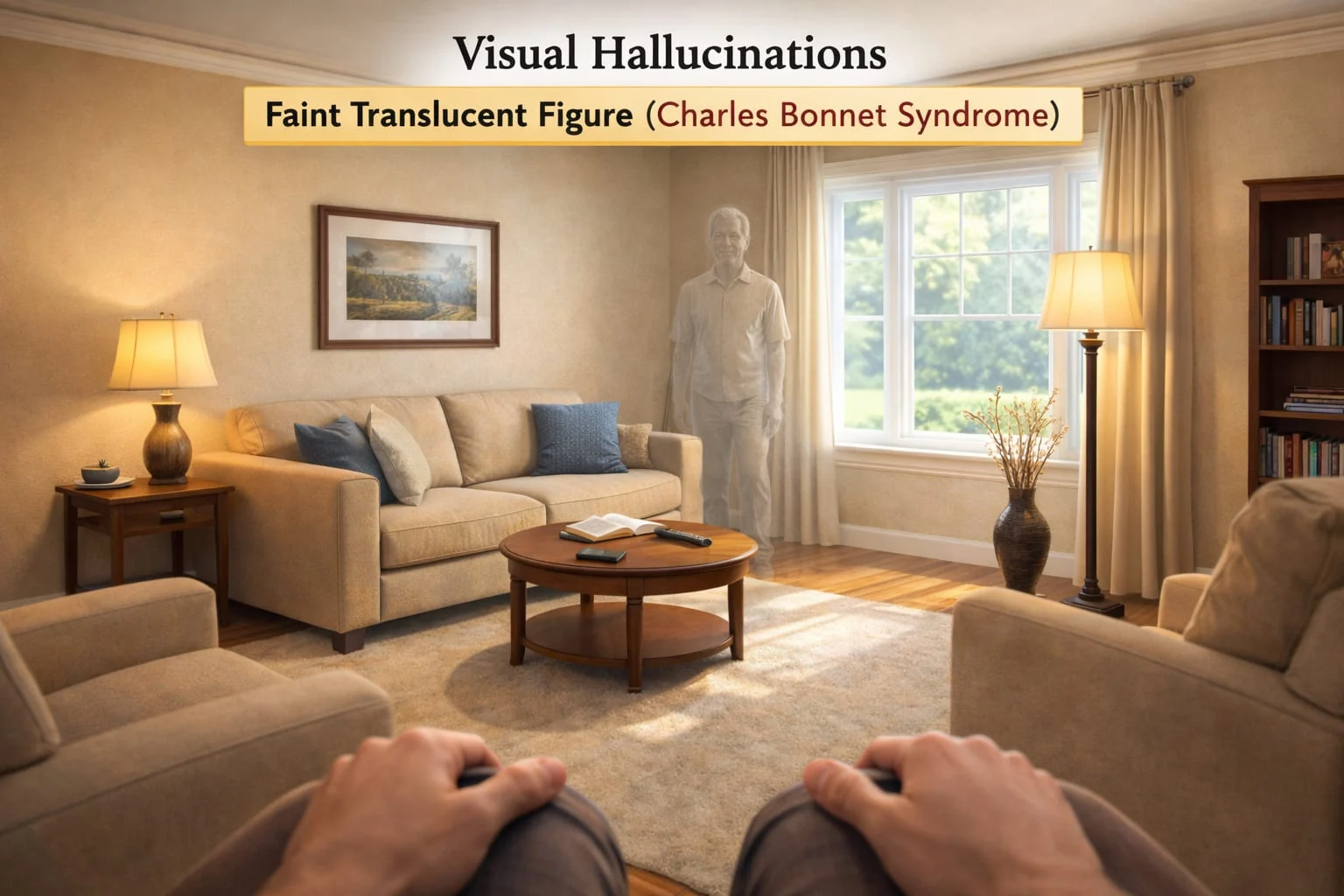
What People Actually See
The hallucinations of CBS are typically detailed and well-formed rather than vague flashes. Common experiences include:
- People or faces, sometimes distorted, miniaturized, or wearing odd costumes
- Animals, often appearing where they obviously could not be
- Repeating geometric patterns, grids, or brickwork-like lattices
- Buildings, landscapes, or whole scenes
- Flashes of color or light, and occasionally small figures (Lilliputian hallucinations)
The images can be still or moving, in color or grayscale, and may last seconds or persist for long stretches. They often appear or worsen in dim light, during inactivity, or when the person is tired. They are not under voluntary control and do not respond to the person's thoughts or wishes - they simply come and go.
Why the Brain Invents Images
The leading explanation is deafferentation, sometimes called a release phenomenon. The visual cortex is built to receive a constant stream of input from the eyes. When disease along the visual pathway reduces that input, deprived regions can become spontaneously overactive and begin producing their own patterns of activity, which are experienced as images. A useful analogy is phantom limb sensation: after an amputation, the brain region that once represented the limb can still generate sensations referred to the missing part. In CBS, the "phantom" is visual. This is why CBS follows vision loss of essentially any cause - the trigger is the loss of input, not a specific disease of the eye.
How We Know It Isn't a Psychiatric Illness
Distinguishing CBS from psychiatric and neurological conditions is the heart of a careful evaluation, and the features that set CBS apart are consistent:
- Preserved insight. People with CBS recognize that the images are not real, even when the images are vivid. In primary psychosis, insight is usually lost and the person believes the experiences are real.
- Purely visual. CBS hallucinations involve only sight. The presence of voices, smells, or tactile sensations points away from CBS and toward other diagnoses.
- No accompanying psychiatric symptoms. There are no delusions, no paranoia, no disorganized thinking, and no mood disturbance driving the experience.
- Normal cognition. CBS does not cause confusion or a fluctuating level of awareness.
These contrasts matter because several other conditions also cause visual hallucinations and require very different management. Dementia with Lewy bodies produces recurrent visual hallucinations, but typically with reduced insight, parkinsonian features, and fluctuating attention. Delirium causes hallucinations in the setting of acute confusion and a clouded sensorium, often from infection, medication, or metabolic upset. Psychosis involves loss of insight and usually other modalities or delusional beliefs. Peduncular hallucinosis from midbrain or thalamic lesions can mimic CBS but arises from a structural brain lesion rather than from vision loss. Certain medications and substance withdrawal can also produce hallucinations. When the picture is typical - formed visual images, full insight, intact thinking, and documented vision loss - CBS is the diagnosis, and an extensive psychiatric or neurologic workup is not needed. When any of those features is missing, further evaluation is warranted.
Who Develops It
CBS can follow vision loss from any cause and at any point along the visual pathway. It is most common in older adults, in part because the eye diseases that cause significant vision loss become more common with age. Macular degeneration is the most frequently associated condition, but CBS also occurs with glaucoma, diabetic retinopathy, advanced cataract, and damage anywhere from the retina to the visual cortex. Estimates of how common CBS is vary widely depending on how it is defined and how directly patients are asked - studies suggest that a meaningful fraction of people with substantial vision loss, in some series 10% or more, experience it. The true number is almost certainly higher than what is reported, because many people never mention the hallucinations out of fear of being labeled mentally ill.
Making the Diagnosis
CBS is a clinical diagnosis based on the pattern, not on a specific scan or blood test. The evaluation centers on:
- A history of formed visual hallucinations with preserved insight
- Documented vision loss
- Absence of hallucinations in other senses
- Normal mental status and no psychiatric disorder driving the experience
Testing is directed by the rest of the picture. If the history is atypical - hallucinations in other senses, lost insight, confusion, new neurological signs, or a fluctuating course - the doctor will look for delirium, a neurodegenerative process, a structural brain lesion, or a medication effect instead of stopping at CBS.
Coping Strategies and Treatment
There is no single drug that reliably cures CBS, and most patients do not need medication at all. The cornerstone is reassurance and explanation: understanding that the brain is generating images because of reduced visual input, and that this does not signal psychiatric illness, dramatically reduces the distress. Practical steps that many patients find helpful include:
- Improving lighting, since hallucinations often intensify in dim surroundings
- Increasing visual and mental engagement - the images tend to appear during inactivity, so conversation, audio, or activity can interrupt them
- Movement tricks during an episode, such as blinking, looking away, or moving the eyes, which sometimes dispels an image
- Treating the underlying eye condition where possible, since improving visual input can reduce the hallucinations
- Low-vision support to make the most of remaining sight; our guide on adapting to vision loss covers practical resources
Medication is reserved for the uncommon cases where hallucinations are frequent and genuinely distressing, and it is used cautiously because the drugs that suppress hallucinations carry their own risks, particularly in older adults. For most people, knowing what CBS is - and that it often eases over time as the brain adapts - is enough to take the fear out of it.
Frequently Asked Questions
Does Charles Bonnet syndrome mean I am developing dementia?
No. CBS by itself is not a sign of dementia. The key difference is insight: in CBS you know the images are not real and your thinking is otherwise normal. Hallucinations from dementia usually come with reduced insight, memory or attention changes, and other neurological features. If those are present, that is worth evaluating - but CBS on its own does not predict dementia.
Will the hallucinations ever go away?
For many people they lessen over time as the brain adapts to the reduced visual input, and they may become less frequent or fade. Others have them on and off for years. They tend to be most troubling at first, largely because they are unexplained; once understood, they are far easier to live with.
Why do I only see things and never hear or smell anything?
Because CBS is specifically a phenomenon of the visual brain responding to lost visual input. Hallucinations in other senses - voices, smells, or touch - point toward a different cause and should be mentioned to your doctor, since they suggest something other than CBS.
Should I tell my doctor, or will they think I'm imagining things?
Please tell your doctor. CBS is a recognized condition, and naming it is genuinely reassuring. Many patients stay silent for years out of embarrassment; bringing it up lets your team confirm the diagnosis, rule out other causes, and help you cope.
Can anything make the hallucinations worse?
They commonly worsen in dim light, when you are tired, and during long periods of inactivity. Better lighting, staying engaged, and rest can all help reduce how often they occur.
References
- American Academy of Ophthalmology EyeWiki. Charles Bonnet Syndrome.
- Royal National Institute of Blind People. Charles Bonnet Syndrome.
Medical Disclaimer: This information is for educational purposes only and does not replace professional medical advice, diagnosis, or treatment.