

An eye injury, called ocular trauma in medical settings, is any injury to the eye or the structures around it. If a chemical has splashed into your eye, start rinsing now with clean, lukewarm water. If an object is embedded in the eye, leave it in place, protect the eye from pressure, and call 911. Eye injuries can worsen quickly, so the first action matters.
Key takeaways
- Eye injuries range from minor (corneal abrasion) to severe (open globe injury)
- Chemical injuries require immediate irrigation: this takes priority over everything else
- Never rub, press, or remove objects from an injured eye
- Penetrating injuries require 911 and a rigid shield placed without pressure
- Protective eyewear prevents many injuries at work, during sports, and at home
- Seek immediate care for any significant eye injury
Questions about your diagnosis? Contact our office
Visual guide: Eye injury: the first action matters
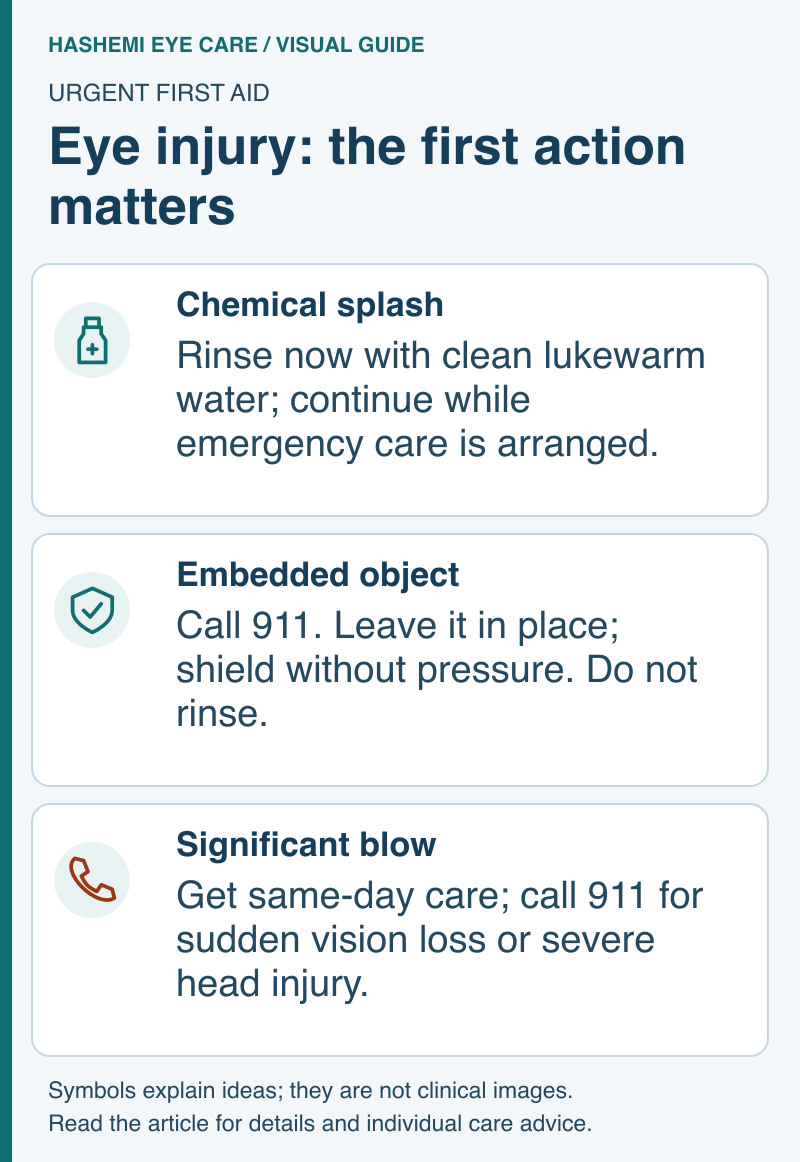
Read this visual as text
Eye Injury First Aid: What to Do Right Now
Chemical Splash
- Start flushing the eye immediately with clean, lukewarm tap water or saline.
- Hold the eyelids open and continue for at least 20 minutes. Remove contact lenses if they come out easily during rinsing.
- Continue irrigation while another person arranges immediate emergency evaluation. Bring the product name or container if this can be done safely.
- Call 911 for severe vision loss, severe pain, breathing symptoms, or an exposure that makes safe transport difficult.
Penetrating Injury or Embedded Object
- Call 911.
- Leave the object in place. Do not pull it out, rinse the eye, or press on the eye.
- Place a rigid eye shield or the bottom of a clean paper cup over the eye without touching the object.
- Keep movement to a minimum while waiting for emergency help.
Blunt Eye Injury
- Place a cool compress over the closed eyelid with no pressure.
- Arrange same-day evaluation for a significant blow, especially with pain, blurred or double vision, blood in the eye, nausea, or restricted eye movement.
- Call 911 for sudden vision loss, severe associated head injury, confusion, weakness, or trouble speaking.
Types of Eye Injuries
| Type of Injury | Common Clues | Initial Urgency |
|---|---|---|
| Corneal abrasion | Sharp pain, tearing, light sensitivity, gritty feeling | Prompt eye care if pain persists or vision is reduced |
| Superficial foreign body | Sand, dust, eyelash, or debris on the surface | Gentle irrigation, then an exam if symptoms remain |
| Chemical injury | Burning after a cleaner, solvent, cement, or other chemical exposure | Irrigate immediately and obtain emergency care |
| Blunt trauma | Bruising, swelling, pain, blood in the eye, double vision | Same-day evaluation after a significant impact |
| Penetrating or open-globe injury | Embedded object, high-speed fragment, visible wound | Call 911, shield without pressure |
| Orbital or eyelid injury | Restricted movement, cheek numbness, deep cut, eyelid deformity | Urgent examination |
Corneal Abrasion
- Scratch on the cornea (front clear surface)
- Very painful
- Tearing and light sensitivity
- Usually heals in 1-3 days
- Risk of infection if not properly treated
Foreign Body
Superficial:
- Debris on eye surface or under eyelid
- Sand, dust, eyelash, metal
- May be removable with irrigation
Embedded/Penetrating:
- Object embedded in cornea or eye
- Requires professional removal
- High-speed particles especially dangerous
Chemical Injury
EMERGENCY: Begin irrigation immediately
- Irrigate with clean water or saline for at least 20-30 minutes
- Don't stop to find special solutions
- Pry eyelids open if needed
- Continue irrigation on the way to emergency care
Alkali burns (lye, drain cleaner, cement):
- Most severe
- Penetrate deeply into eye tissue
- Can cause devastating damage
Acid burns (battery acid, pool chemicals):
- Generally less severe than alkali
- Still require immediate irrigation and care
Blunt Trauma
- Fist, ball, airbag deployment
- Can cause:
- Hyphema (blood in front of eye)
- Lens dislocation
- Retinal detachment or retinal macroaneurysm rupture
- Orbital fracture
- Optic nerve damage
Penetrating/Open Globe Injury
- Sharp object penetrates eye wall
- Medical emergency
- Do NOT:
- Press on the eye
- Remove embedded objects
- Irrigate the eye
- Shield the eye without pressure
- Call 911
Orbital Fracture
- Broken bones around the eye
- Often from blunt trauma
- May cause:
- Double vision
- Sunken appearance
- Numbness of cheek
- Restriction of eye movement
Eyelid Laceration
- Cuts to the eyelid
- May need surgical repair
- Special concern if near inner corner (tear drainage)
Detailed First Aid by Injury Type
General Principles
Avoid rubbing or pressure, leave embedded objects in place, and use the immediate first-aid steps above. Do not delay care to work out the exact injury type.
For Corneal Abrasion/Superficial Foreign Body
- Wash hands
- Try to flush with clean water or saline
- Blink repeatedly
- Don't rub
- Seek care if persistent pain or decreased vision
For Chemical Exposure
Start rinsing immediately. Follow the chemical splash instructions, including continued irrigation while emergency care is arranged.
For Blunt Trauma
Follow the blunt eye injury steps. Significant blows need evaluation even when external bruising appears minor.
For Penetrating Injury/Embedded Object
Call 911 and follow the penetrating injury instructions. Do not rinse, press on the eye, or remove the object.
When to Seek Emergency Care
Call 911 for a penetrating injury or embedded object. Obtain immediate emergency evaluation for:
- Chemical exposure (after starting irrigation)
- Severe eye pain
- Vision loss or significant vision changes
- Blood visible inside the eye
- A pupil that looks irregular, teardrop-shaped, or unequal after the injury
- Eye that won't move normally
- Something that hit the eye at high speed
- Nausea or vomiting after a blow to the eye
How Eye Injuries Are Evaluated
Examination
- Visual acuity testing
- External inspection
- Slit-lamp examination
- Pupil assessment
- Eye pressure measurement (if safe)
- Dilated fundus exam (if indicated)
Imaging
- CT scan for orbital fractures or suspected foreign body
- Ultrasound in selected cases after an open-globe injury has been excluded or repaired
Treatment by Injury Type
Corneal Abrasion
- Antibiotic drops or ointment
- Pain management
- Follow-up to ensure healing
- Usually heals in 24-72 hours
Foreign Body
- Professional removal
- Antibiotic prophylaxis
- Tetanus update if needed
- Monitoring for infection
Chemical Injury
- Continued irrigation
- pH testing until normalized
- Possible hospital admission
- Long-term follow-up for complications
- May need surgery in severe cases
Hyphema (Blood in the Eye)
- Activity restriction with the head elevated
- Review aspirin, anticoagulants, and other medicines with the treating clinician; do not stop a prescribed medicine on your own
- Daily monitoring initially
- Watch for pressure elevation
- May need surgery if severe
Open Globe/Penetrating Injury
- Shield eye (no pressure)
- IV antibiotics
- Tetanus update
- Emergency surgery
- Avoid straining, coughing, bending
Orbital Fracture
- Observation for mild cases
- Surgical repair if:
- Significant double vision
- Eye position affected
- Large fracture
Prevention
Protective eyewear can prevent many serious eye injuries:
Protective Eyewear Recommendations
- Work: Safety glasses/goggles for construction, manufacturing, laboratory
- Sports: Sport-specific protective eyewear (polycarbonate)
- Home: Safety glasses for yard work, power tools, cleaning chemicals
- Children: Supervise activities, appropriate safety eyewear
High-Risk Activities
- Power tool use
- Yard work (mowers, trimmers, chainsaws)
- Sports (basketball, racquet sports, baseball)
- Working with chemicals
- Grinding, hammering, drilling
- Fireworks
Frequently Asked Questions
How do I know if my injury is serious?
Assume any significant eye injury is serious until evaluated by a professional. Vision changes, severe pain, blood in the eye, or high-speed impact all warrant immediate evaluation.
Can I sleep with an eye injury?
For minor corneal abrasions, you can sleep. Your doctor may recommend an ointment at bedtime. For more significant injuries, follow your doctor's specific instructions.
How long does a scratched cornea take to heal?
Most minor corneal abrasions heal within 24-72 hours. Larger abrasions may take longer. Contact lens-related abrasions may need extra care due to infection risk.
Will I need surgery for an eye injury?
Many injuries heal without surgery. Surgery may be needed for penetrating injuries, some orbital fractures, severe lacerations, or retained foreign bodies. Your ophthalmologist will determine what's needed.
Should I use eye drops after an injury?
Don't use drops or ointments without professional guidance, especially if there's any chance of penetrating injury. Your doctor will prescribe appropriate medications.
Can I wear contacts after an eye injury?
Wait until fully healed and cleared by your eye doctor. Contacts can increase infection risk with open wounds.
References
- National Eye Institute. First Aid Tips.
- MedlinePlus. Eye Emergencies.
- Mayo Clinic. Chemical Splash in the Eye: First Aid.
- Kuhn F, et al. The Birmingham Eye Trauma Terminology (BETT). J Fr Ophtalmol. 2004.
- Bord SP, Linden J. Trauma to the globe and orbit. Emerg Med Clin North Am. 2008;26(1):97-123.
Medical Disclaimer: This information is for educational purposes only and does not replace professional medical advice, diagnosis, or treatment. If you have an eye injury, seek immediate professional care, especially for chemical exposures, penetrating injuries, or vision changes.