

Cyclosporine eye drops are prescription immunomodulator medications that reduce inflammation on the ocular surface and help restore natural tear production. They are a cornerstone treatment for moderate to severe dry eye disease and are available in several formulations including Restasis (0.05%), Cequa (0.09%), and generic versions.
Key takeaways
- Reduces ocular surface inflammation to restore tear production
- Available in multiple formulations: Restasis, Cequa, generic
- Twice daily dosing: one drop in each eye every 12 hours
- Takes weeks to months for full effect; patience is essential
- Targets the inflammation that drives dry-eye symptoms
- Can be used alongside artificial tears and other treatments
Questions about your diagnosis? Contact our office
Visual guide: Cyclosporine drops: allow time for benefit
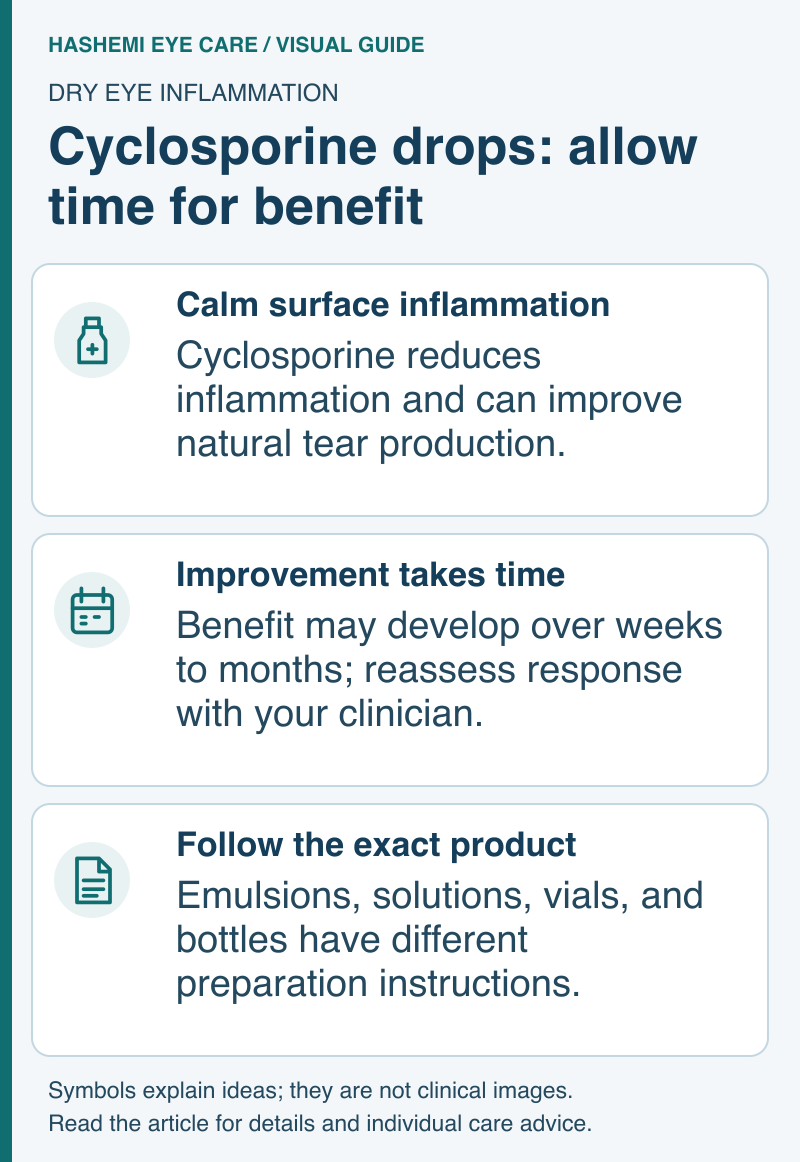
Read this visual as text
How It Works
Cyclosporine is an immunomodulator that:
- Reduces T-cell mediated inflammation on the eye surface
- Decreases inflammatory cytokines in the tears
- Allows the lacrimal gland to function more effectively
- Restores natural tear production over time
- Breaks the cycle of inflammation → dry eye → more inflammation
Common Uses
- Moderate to severe dry eye syndrome
- Inflammatory dry eye (positive MMP-9)
- Meibomian gland dysfunction with inflammation
- When artificial tears alone aren't sufficient
- After punctal plug placement to address underlying inflammation
- Post-refractive surgery dry eye
Available Formulations
| Brand | Concentration | Vehicle | Key Feature |
|---|---|---|---|
| Restasis | 0.05% | Emulsion | Original; widely available |
| Cequa | 0.09% | Nanomicellar solution | Higher concentration; better penetration |
| Generic | 0.05% | Emulsion | Lower cost option |
How to Use
- Dosing: One drop in each eye twice daily, approximately 12 hours apart
- Preparation: Restasis emulsion vials are inverted a few times until uniformly white and opaque. Cequa is a solution. Restasis MultiDose needs first-use priming and mixing; follow the instructions for your exact product
- Instillation: Wash hands, tilt head back, pull down lower eyelid, apply drop
- After instillation: Close eyes gently for 1-2 minutes
- Single-use vials: Discard after use (preservative-free)
- Contact lenses: Remove before use; wait 15 minutes before reinserting
- With artificial tears: Can use together; wait 15 minutes between different drops
- Consistency: Use at the same times daily for best results
What to Expect
Timeline
| Time Period | What to Expect |
|---|---|
| Weeks 1-4 | May notice burning; limited improvement yet |
| Months 1-3 | Gradual improvement may begin |
| Months 3-6 | Assess symptoms and eye-surface findings with your clinician; response varies |
| Ongoing | Continue use to maintain benefits |
Important Points
- Continue using artificial tears for comfort while waiting for cyclosporine to take effect
- Don't stop too early; the medication needs time to reduce inflammation
- Consistent use is critical to success
- Some patients respond faster than others
Side Effects
Common
- Burning or stinging upon instillation (15-20% of patients)
- Eye redness
- Watery eyes
- Blurred vision (temporary)
- Discharge
Less Common
- Eye pain
- Foreign body sensation
- Itching
- Visual disturbance
Managing Burning
- Often improves with continued use over weeks
- Follow labeled room-temperature storage; ask a pharmacist before changing it
- Leave 15 minutes between Restasis or Cequa and lubricant drops
- Some patients find Cequa's formulation more comfortable than emulsion
Precautions
- Active eye infections: Don't use during active infection
- Contact lenses: Remove before use; wait 15 minutes to reinsert
- Herpes keratitis: Use with caution in patients with history
- Pregnancy/breastfeeding: Discuss with doctor
- Immunocompromised patients: Use with caution
Comparing Options
See prescription dry-eye comparisons for practical differences. Ask which part of your examination the medicine is targeting, when to reassess it, and how to manage irritation without dropping or combining prescribed doses yourself.
Frequently Asked Questions
What's the difference between Restasis and Cequa?
Both contain cyclosporine but at different concentrations and in different formulations. Cequa (0.09%) has a higher concentration and uses nanomicellar technology for better drug penetration. Restasis (0.05%) is the original formulation and is available as generic.
How long do I need to use cyclosporine?
Dry eye is typically a chronic condition. Most patients use cyclosporine indefinitely to maintain improvement. Stopping usually leads to symptom recurrence because the medication controls, rather than cures, the underlying inflammation.
Why does it burn when I put it in?
Temporary burning can occur and may improve. Lubricant drops can help when separated by 15 minutes. Contact the prescriber for severe or persistent burning, increasing redness, pain, or worsening vision.
Can I use cyclosporine with artificial tears?
Yes, and it's recommended, especially during the initial weeks when cyclosporine hasn't yet taken full effect. Artificial tears provide immediate comfort. Wait 15 minutes between different eye drops.
Is generic cyclosporine as effective as brand-name?
Generic cyclosporine 0.05% contains the same active ingredient as Restasis. Most patients do well with generic versions. If you notice a significant difference, discuss with your doctor.
What if cyclosporine doesn't work?
Ask for a follow-up after consistent use to check technique, tolerability, symptoms, and the eye surface. Benefits can take months, but worsening vision or significant pain needs earlier assessment. Formulation changes, Xiidra, or other treatments may be appropriate.
For help comparing lubricating drops, see how to choose eye drops for dry eyes.
References
- DailyMed. Restasis 0.05% single-use emulsion prescribing information.
- DailyMed. Restasis MultiDose prescribing information and bottle instructions.
- DailyMed. Cequa 0.09% solution prescribing information.
Medical Disclaimer: This information is for educational purposes only and does not replace professional medical advice. Follow your doctor's instructions regarding this medication.