

Erythromycin ophthalmic ointment is a prescription antibiotic eye ointment used for certain bacterial infections of the eye. It is commonly prescribed for bacterial conjunctivitis, some eyelid margin infections such as blepharitis, and infection prevention in selected situations.
It is a generic macrolide antibiotic. Older or listed brand names include Ilotycin and Romycin. Erygel is an erythromycin skin medication. Keep Erygel and other non-ophthalmic erythromycin products out of the eye.
Key takeaways
- Treats bacterial eye infections such as bacterial conjunctivitis when the organism is susceptible
- Will not treat viral pink eye or allergy-related red eyes
- Often blurs vision temporarily because ointment coats the eye surface
- Usually applied as a thin ribbon inside the lower eyelid or to the eyelid margin
- Used in newborns at birth to help prevent gonococcal eye infection; it does not prevent chlamydial eye infection
- Finish the prescribed course even if the eye looks better early
Questions about your diagnosis? Contact our office
Visual guide: Erythromycin: use the eye formulation
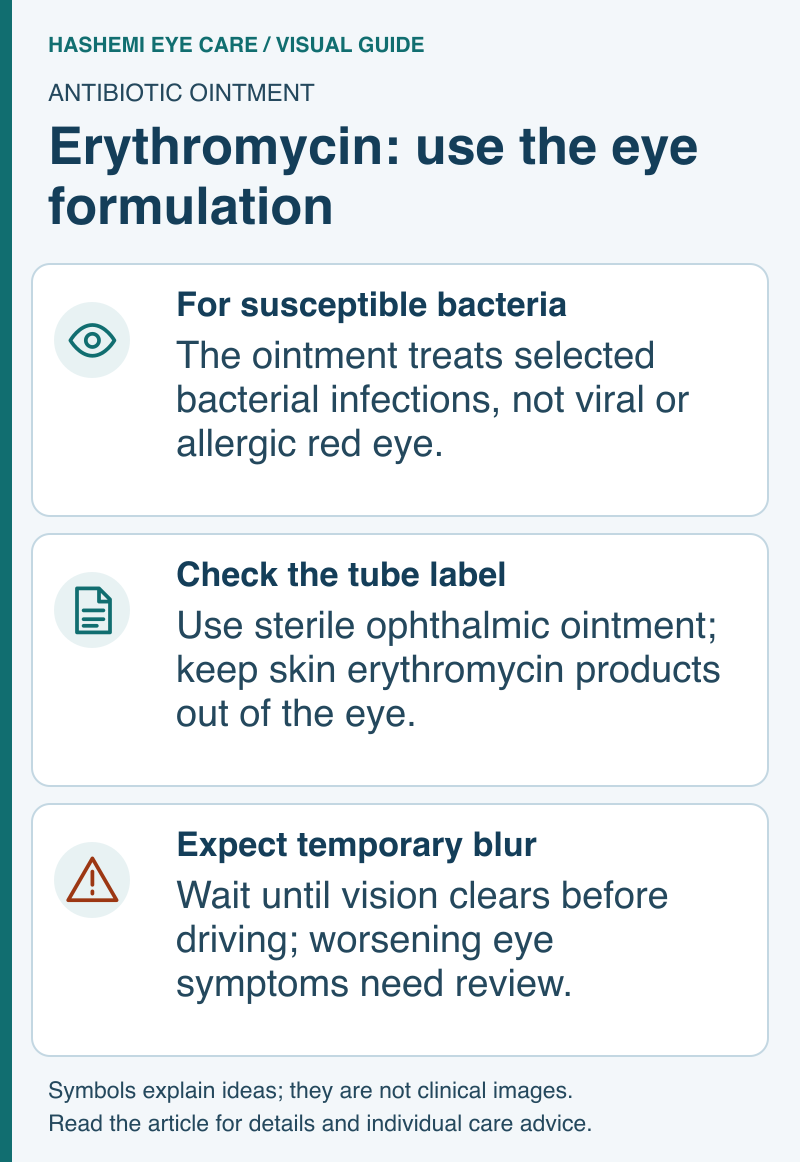
Read this visual as text
How Erythromycin Ointment Works
Erythromycin belongs to the macrolide antibiotic class. It works by binding to the bacterial 50S ribosomal subunit and blocking bacterial protein synthesis. In practical terms, it stops susceptible bacteria from growing and multiplying, allowing the immune system and the medication course to clear the infection.
Conditions Treated With Erythromycin Ointment
Erythromycin ointment may be used for:
- Bacterial conjunctivitis, often called bacterial pink eye
- Blepharitis when an antibiotic ointment is applied to the eyelid margins
- Selected infected styes (hordeola) when a clinician wants antibiotic coverage along the eyelid margin
- Mild superficial bacterial eye infections involving the conjunctiva or corneal surface when susceptible bacteria are likely
- Corneal abrasion prophylaxis, to reduce infection risk while the surface heals
- Selected corneal ulcer or keratitis situations, depending on severity, contact lens status, and culture results
- Newborn eye prophylaxis, given soon after birth to help prevent gonococcal conjunctivitis; topical erythromycin does not prevent chlamydial conjunctivitis
- Post-procedure prophylaxis when your ophthalmologist wants short-term surface antibiotic coverage
Not every red eye needs an antibiotic. Many cases of conjunctivitis are viral or allergic, and antibiotics do not help those causes.
Erythromycin Ophthalmic Ointment for Pink Eye
Erythromycin ophthalmic ointment can treat bacterial pink eye, also called bacterial conjunctivitis, when the infection is caused by susceptible bacteria. Thick discharge and eyelids that mat together can occur with bacterial conjunctivitis. Viral conjunctivitis often causes watery discharge and may occur with a cold, while allergic conjunctivitis commonly causes itching in both eyes. These patterns can overlap, so an examination may be needed to identify the cause.
Viral and allergic conjunctivitis require different care. Contact an eye doctor when symptoms worsen or do not begin improving after 24 hours of antibiotic treatment. A painful red eye, light sensitivity, decreased vision, contact lens use, or a white or gray spot on the cornea needs same-day eye care.
How to Use Erythromycin Eye Ointment
Always follow the directions on your prescription label and the instructions from your doctor. A common technique is:
- Wash your hands with soap and water.
- Remove contact lenses unless your doctor specifically told you otherwise.
- Tilt your head back slightly.
- Gently pull down the lower eyelid to make a small pocket.
- Hold the tube close to the eye without touching the tip to your eye, eyelid, lashes, fingers, or skin.
- Squeeze a thin ribbon of ointment into the lower eyelid pocket. Many prescriptions use about a 1 cm (about 3/8-inch) ribbon unless your doctor gives different instructions.
- Close the eye gently for 1-2 minutes. Rolling the eye can help spread the ointment.
- Wipe excess ointment from the eyelids or lashes with a clean tissue.
- Replace the cap right away.
- Wash your hands again.
Your vision will usually blur after application. This is expected with ointments and is one reason many patients prefer bedtime dosing when the schedule allows it.
Typical Dosing
Your exact schedule depends on the diagnosis and severity.
| Situation | Common Pattern | Notes |
|---|---|---|
| Bacterial conjunctivitis or superficial infection | Often 2-4 times daily; some labels allow up to 6 times daily for more severe infection | Complete the full course |
| Blepharitis | Often applied to the eyelid margins, commonly at bedtime | Usually paired with lid hygiene |
| Corneal abrasion prophylaxis | Often at bedtime or several times daily depending on the abrasion | Follow-up matters if pain or blur persists |
| Newborn prophylaxis | Single application by hospital staff soon after birth | A new tube is used for each infant |
Do not increase frequency or extend treatment on your own. If symptoms are not improving, the diagnosis or antibiotic choice may need to be reassessed.
Contact Lenses
Do not wear contact lenses while treating an active eye infection unless your eye doctor specifically tells you it is safe. Contact lenses can worsen infection risk and can hide symptoms of a more serious corneal problem.
If erythromycin is being used for a non-infectious reason and your doctor allows lens wear, wait until vision clears and follow the timing your clinician gives you before reinserting lenses. When in doubt, leave lenses out and ask.
What to Expect
After applying erythromycin ointment, it is common to notice:
- Temporary blurred vision
- Greasy or sticky feeling on the eye or lashes
- Mild stinging, burning, redness, or irritation
- Improvement in bacterial infection symptoms within a few days
Call your doctor if the eye is not beginning to improve after 24 hours of antibiotic treatment, symptoms worsen, or you develop new pain, light sensitivity, discharge, swelling, or decreased vision.
Erythromycin Ophthalmic Ointment Side Effects
Most side effects are temporary and limited to the eye surface or eyelids. Persistent or worsening symptoms deserve medical guidance.
Common Side Effects
- Temporary blurred vision from the ointment
- Mild irritation, stinging, burning, itching, or redness
- Sticky eyelids or lashes after use
Less Common but Important
- Allergic reaction, including rash, hives, swelling, or severe itching
- New or worsening eye pain
- Worsening redness, irritation, or discharge
- Secondary infection with prolonged or inappropriate use
Stop using the medication and call 911 for trouble breathing, throat swelling, or another severe allergic reaction. Rapidly worsening eye symptoms need urgent eye assessment.
Important Safety Information
- Use only in the eye if the tube is labeled for ophthalmic use.
- Do not share the tube with anyone else.
- Do not touch the tube tip to the eye, eyelid, lashes, fingers, or any surface.
- Tell your doctor about allergies to erythromycin, other macrolide antibiotics, preservatives, or prior eye medication reactions.
- Tell your doctor about other eye medications you use. You may need to separate drops and ointments by several minutes.
- Do not stop early unless your clinician tells you to. Stopping too soon can leave infection partially treated.
- Wait until vision clears before driving or doing tasks that require sharp vision.
- Store as directed on the label, typically at room temperature and away from excess heat. Do not freeze unless the product labeling says otherwise.
What Does "Not for Ophthalmic Use" Mean?
A label that says "not for ophthalmic use" identifies a product made for the skin or another body area. Keep that product out of the eye. A tube intended for the eye should identify the product as ophthalmic and sterile. Ask a pharmacist to verify the product when the label is unclear.
Can Erythromycin Ophthalmic Ointment Be Used on the Skin?
Erythromycin ophthalmic ointment is formulated for the eye. A clinician may direct its use on the eyelid skin, lash line, or a nearby surgical incision in selected situations. Use on other skin conditions requires specific instructions from a clinician. Erythromycin skin gels and solutions are different products and should stay out of the eye.
Does Erythromycin Ophthalmic Ointment Expire?
Yes. Check the expiration date printed on the tube crimp and box. Follow the product label or pharmacist's instructions for storage and disposal after opening. Discard a tube when the seal is broken before first use or the tip becomes contaminated. Ask a pharmacist before using ointment that has changed color or texture.
When to Seek Same-Day Eye Care
Get prompt eye care, and do not wait for routine follow-up, if you have:
- Moderate or severe eye pain
- Light sensitivity
- A white or gray spot on the cornea
- Decreased vision
- Contact lens wear with a painful red eye
- Copious pus-like discharge
- Swelling around the eye
- Symptoms in a newborn or very young infant
- Bacterial pink eye not beginning to improve after 24 hours of antibiotic treatment
These symptoms can signal a problem more serious than routine conjunctivitis, including keratitis, corneal ulcer, gonococcal conjunctivitis, or infection inside the eye.
How It Compares With Other Antibiotics
Choice depends on the organism, lens use, allergies, age, and corneal involvement. See antibiotic eye ointments for the practical differences. Do not switch products yourself: treatment for routine conjunctivitis may be inadequate for a corneal ulcer or contact-lens infection.
Special Situations
Newborn Prophylaxis
Erythromycin 0.5% ophthalmic ointment is commonly placed in both eyes shortly after birth to help prevent gonococcal ophthalmia neonatorum, a severe newborn eye infection caused by gonorrhea. It does not prevent chlamydial eye infection; prevention of that infection depends on prenatal screening and treatment. Newborn redness, swelling, or discharge still needs prompt medical evaluation because birth prophylaxis does not cover every cause and does not replace treatment of an established infection.
Pregnancy and Breastfeeding
Tell your prescriber if you are pregnant or breastfeeding. The ophthalmic label advises use during pregnancy only when needed and caution during breastfeeding. Your clinician can confirm whether this antibiotic is appropriate for the current eye problem.
Frequently Asked Questions
How long does erythromycin ointment take to work?
Many bacterial eye infections start improving within 2-3 days. Finish the prescribed course even if symptoms improve earlier. Contact your doctor if symptoms worsen or bacterial pink eye has not started improving after 24 hours of antibiotic use.
Why is my vision blurry after using the ointment?
Ointment temporarily coats the eye surface, which blurs vision. This is expected and usually clears as the ointment spreads and thins. Avoid driving until you can see clearly.
Can I wear contact lenses while using erythromycin ointment?
Usually no, especially if you are treating an eye infection. Leave lenses out until your doctor says the infection has resolved and it is safe to resume lens wear.
What if I miss a dose?
Apply the missed dose when you remember. If it is almost time for your next scheduled dose, skip the missed dose. Do not apply extra ointment to make up for a missed dose.
Is erythromycin eye ointment safe for children?
It is used in children and newborns when indicated. Dosing and urgency depend on the diagnosis. Newborn eye discharge, swelling, or redness requires prompt medical evaluation before home treatment.
Can I use leftover erythromycin eye ointment?
Use a current tube prescribed for the present eye problem. Check the expiration date, seal, and tip cleanliness, and ask a clinician or pharmacist before reusing a previously opened tube.
Is Ilotycin the same as erythromycin ophthalmic ointment?
Ilotycin is an older brand name for erythromycin ophthalmic ointment. The generic product is usually labeled erythromycin ophthalmic ointment USP 0.5%, which contains 5 mg of erythromycin per gram.
Learn More
- Antibiotic Eye Ointments: What They Treat and How They Differ
- Blepharitis
- Stye (Hordeolum)
- Corneal Ulcer
- Medication Guide
References
-
Centers for Disease Control and Prevention. Gonococcal Infections Among Neonates: Preventing Ophthalmia Neonatorum.
-
Centers for Disease Control and Prevention. Chlamydial Infections: Preventing Ophthalmia Neonatorum.
-
Centers for Disease Control and Prevention. How to Treat Pink Eye.
-
DailyMed. Erythromycin Ophthalmic Ointment USP 0.5% prescribing information.
-
MedlinePlus. Erythromycin Ophthalmic.
-
Cleveland Clinic. Erythromycin Eye Ointment.
Medical Disclaimer: This information is for educational purposes only and does not replace professional medical advice, diagnosis, or treatment. Use erythromycin ophthalmic ointment only as prescribed and contact your eye doctor for worsening symptoms, significant pain, vision changes, or concerns about medication reactions.