

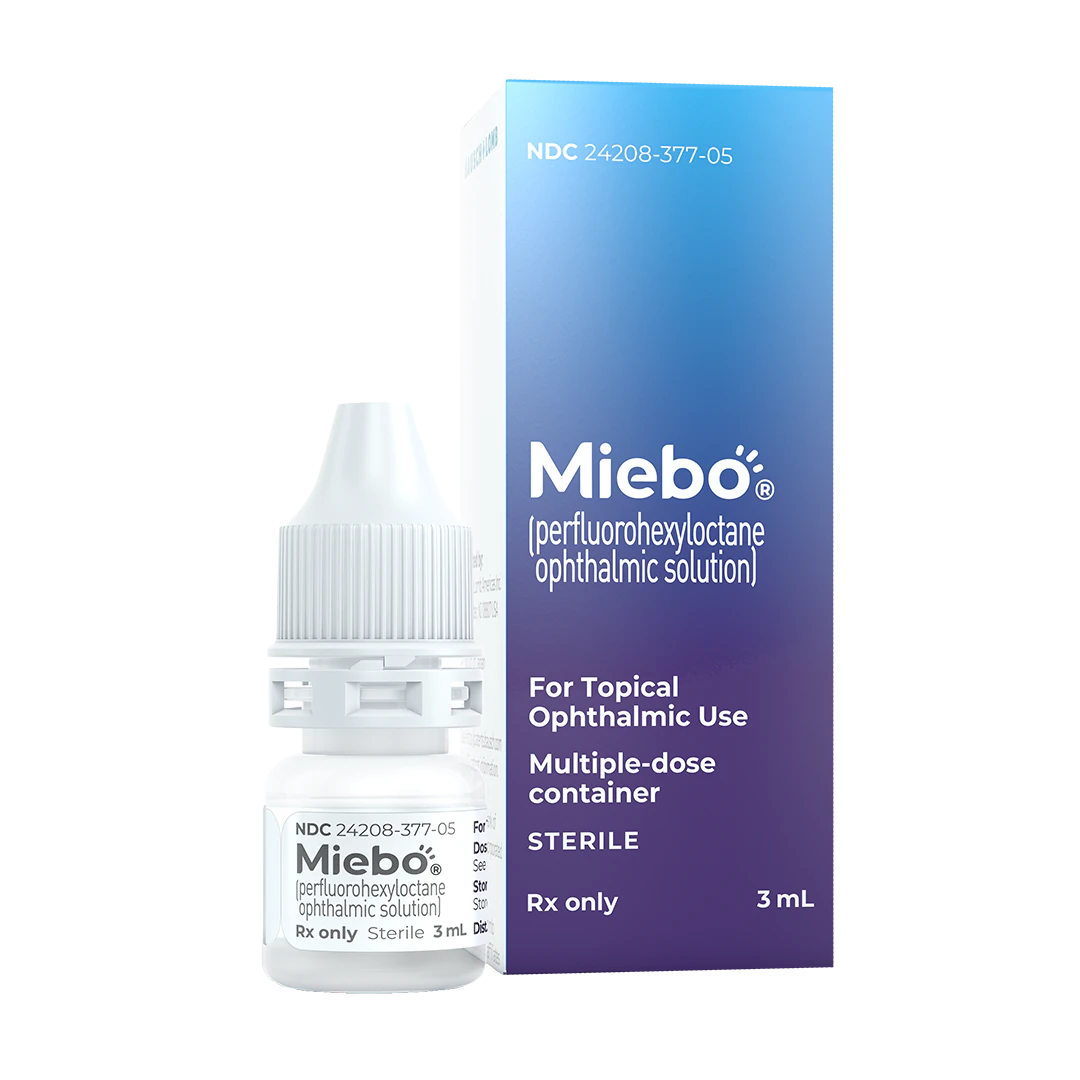
Miebo (Perfluorohexyloctane)
Prescription eye drops for dry eye disease that prevent tear evaporation by supplementing the lipid layer.
Drug Class: Tear Evaporation Inhibitors
Miebo (perfluorohexyloctane ophthalmic solution) is a prescription eye drop for treating signs and symptoms of dry eye disease. It works by directly reducing tear evaporation, an approach that can be particularly useful for evaporative dry eye.
Official website: miebo.com
Key takeaways
- Targets tear evaporation by forming a layer at the surface of the tear film
- Uses a different mechanism from anti-inflammatory dry eye drops
- Four times daily dosing
- Works on the lipid layer of the tear film
- Contact lenses must be removed before each dose and kept out for at least 30 minutes
Questions about your diagnosis? Contact our office
How It Works
Miebo takes an evaporation-focused approach to dry eye:
- Creates a protective layer on the eye surface
- Prevents tears from evaporating
- Forms a monolayer at the air-liquid surface of the tear film
- Particularly helpful when meibomian glands aren't producing enough oil
Miebo reduces evaporation through a physical surface effect. Cyclosporine drops and lifitegrast target inflammatory pathways involved in dry eye.
Common Uses
- Evaporative dry eye disease
- Meibomian gland dysfunction (MGD)
- Dry eye with good tear production but rapid evaporation
- May be used with or without anti-inflammatory drops
How to Use
- Dosing: One drop in each eye four times daily
- Contact lenses: Remove before each dose and wait at least 30 minutes before reinserting
- Instillation: Wash your hands, prepare the bottle as directed, and apply one drop without touching the tip to your eye
- Multi-dose bottle: The current FDA label allows use through the expiration date printed on the bottle after opening
- Storage: Room temperature
What to Expect
Timeline
- In clinical trials, group-level improvements in dry-eye signs and symptoms were measured by Day 15 and again at Day 57
- Individual response and timing vary
- Continue on the schedule prescribed by your eye doctor
Unique Features
- Contact lenses must be removed before use and kept out for at least 30 minutes
- Different mechanism allows combination with other dry eye treatments
- Its evaporation-focused mechanism can complement anti-inflammatory treatment
Side Effects
In FDA-reviewed trials, blurred vision and conjunctival redness were reported in 1% to 3% of participants. Hypersensitivity reactions were also reported in premarketing studies. Contact your prescriber for persistent redness, swelling, worsening discomfort, or another possible allergic reaction.
Precautions
- Allergy: Do not use Miebo if you have had a hypersensitivity reaction to perfluorohexyloctane
- Keep tip clean: don't touch to eye or other surfaces
- Pregnancy/breastfeeding: Human pregnancy and lactation data are limited, so discuss the expected benefits and uncertainties with your clinicians
- Multi-dose bottle: Follow the expiration date printed on the bottle
For a full side-by-side comparison of all prescription dry eye medications, see comparing dry eye prescription drops.
Is Miebo a PFAS?
Miebo contains 100% perfluorohexyloctane, a semifluorinated alkane with six perfluorinated carbon atoms and eight hydrogenated carbon atoms. Under broad structural definitions used by the U.S. Environmental Protection Agency, that chemistry places perfluorohexyloctane within the large PFAS family.
PFAS is a broad structural category covering thousands of compounds. Perfluorohexyloctane is chemically distinct from well-studied environmental contaminants such as PFOA and PFOS, so findings about those compounds cannot be automatically applied to Miebo. The FDA label reports low blood levels after topical eye use and also states that human pharmacokinetics have not been quantitatively characterized. Broader environmental persistence questions remain separate from the FDA's evaluation of Miebo for its labeled medical use.
What are alternatives to Miebo without perfluorohexyloctane?
Options that use other active ingredients include cyclosporine drops such as Restasis and Cequa, Xiidra, and artificial tears. Each treatment addresses a different part of dry eye disease. An eye exam can identify whether evaporation, inflammation, low tear production, or a combination is driving your symptoms.
How Miebo Differs from Anti-Inflammatory Dry Eye Drops
Miebo primarily targets tear evaporation. Restasis, Cequa, and Xiidra act on inflammatory pathways involved in dry eye, which can influence tear production and ocular-surface health. Some patients have both evaporative and inflammatory dry eye and may receive treatments from more than one category.
| Treatment | How It Works | Best For |
|---|---|---|
| Miebo | Prevents evaporation | Evaporative dry eye, MGD |
| Restasis/Cequa | Cyclosporine targets ocular-surface inflammation | Dry eye with an inflammatory component |
| Xiidra | Lifitegrast targets ocular-surface inflammation | Dry eye with an inflammatory component |
| Artificial tears | Temporary lubrication | All types (symptom relief) |
Using Miebo with Other Treatments
Miebo can be used alongside:
- Anti-inflammatory drops (Restasis, Cequa, Xiidra)
- Artificial tears
- Warm compresses for MGD
- Omega-3 supplements
This combination approach addresses multiple aspects of dry eye.
Frequently Asked Questions
Can I use Miebo with my contact lenses?
No. Remove contact lenses before using Miebo and wait at least 30 minutes before reinserting them.
Is Miebo better than Restasis or Xiidra?
They work differently. Miebo prevents evaporation; Restasis, Cequa, and Xiidra reduce inflammation. Miebo may be better for purely evaporative dry eye, while inflammatory dry eye may need the other medications. Some patients benefit from combining approaches.
Why is Miebo dosed four times daily?
Four times daily is the FDA-approved schedule studied in the clinical trials. Keep the frequency exactly as prescribed.
How long should I use Miebo?
The FDA label gives a four-times-daily dose and does not set a fixed treatment length. Miebo is commonly used as ongoing dry-eye management, with follow-up based on symptom relief, eye-surface findings, tolerability, and cost. Use it for the duration your prescriber recommends.
Will my vision be blurry after using Miebo?
Some temporary blur right after instillation can occur. It typically clears quickly.
Can I use artificial tears with Miebo?
Yes, artificial tears can be used alongside Miebo. If using multiple drops, wait a few minutes between them.
How do I know if I have evaporative dry eye?
Your eye doctor can determine if your dry eye is primarily evaporative (often from meibomian gland dysfunction) or from reduced tear production. Signs include rapid tear break-up time and meibomian gland changes.
References
- U.S. Food and Drug Administration. Miebo prescribing information.
- National Library of Medicine. PubChem: Perfluorohexyloctane.
- U.S. Environmental Protection Agency. Background on structural definitions of PFAS.
Medical Disclaimer: This information is for educational purposes only and does not replace professional medical advice. Follow your doctor's instructions regarding this medication.