

An altitudinal visual field defect is loss of the upper or lower half of vision in one eye, with the missing area stopping cleanly along a horizontal line through the center of sight. That horizontal border is the whole story. Where a defect that respects the vertical midline points to the optic chiasm or visual pathways behind it, a defect that respects the horizontal midline points the other way - toward the optic nerve head or the retina, and usually toward their blood supply.
Call 911 for a sudden new missing area of vision, even if it is painless or improves. A retinal artery occlusion (CRAO or BRAO) is an eye stroke and cannot be distinguished from other causes at home. Sudden balance loss, face droop, arm weakness or speech trouble are additional BE-FAST stroke signs. Do not drive yourself.
Key takeaways
- The horizontal border is the signature - the loss takes a top or bottom half and stops at the midline, unlike a quadrant or a vertical-midline defect
- It usually means the optic nerve head or retina, most often a circulation problem rather than a brain lesion
- The classic cause is ischemic optic neuropathy - non-arteritic (NAION) much more often, but the arteritic form from giant cell arteritis is a same-day emergency
- A branch retinal artery occlusion is a retinal stroke and shares the same urgency as a stroke elsewhere
- The fellow eye is the priority - much of the workup exists to protect the second eye from the same process
Questions about your diagnosis? Contact our office
Visual guide: Altitudinal loss: an upper or lower half
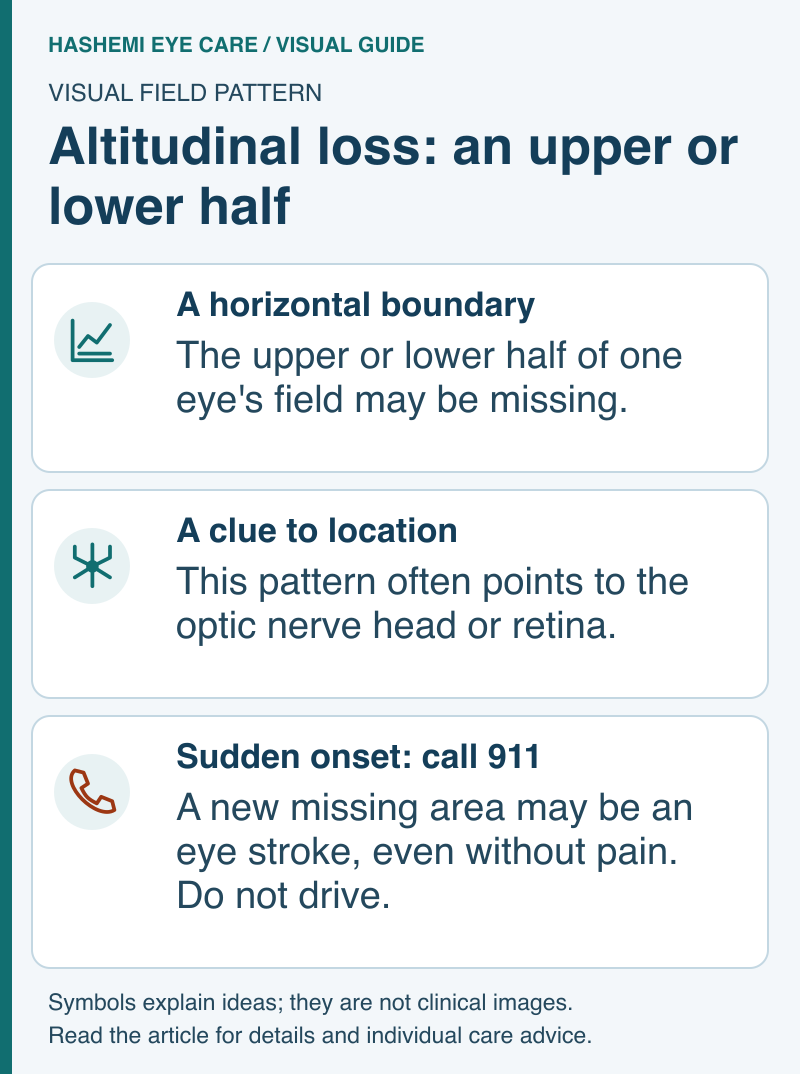
Read this visual as text
The Horizontal-Midline Signature
The retina is organized into upper and lower halves that meet along a seam called the horizontal raphe, and the nerve fibers carrying the top of vision stay separate from those carrying the bottom all the way to the optic nerve head. Vision in the upper field is served by the lower retina and lower nerve fibers, and vision in the lower field by the upper ones. Because the blood supply to the optic nerve head and to the retina is also split into upper and lower territories, an event that knocks out one of those territories tends to wipe out a clean top or bottom half of the field - and the loss stops at the horizontal line because the other half is fed by a separate vessel.
Patients describe it in physical terms: "the bottom dropped out," "everything above a line is gray," difficulty seeing steps and curbs with an inferior defect, or missing overhead signs and shelves with a superior one. Inferior altitudinal loss tends to be the more commonly reported pattern, partly because the upper part of the optic nerve head is especially vulnerable in ischemic events.
Why a Horizontal Border Points to the Nerve Head
The optic nerve head is supplied by a ring of small vessels (the short posterior ciliary arteries) arranged so that the upper and lower poles draw on partly separate sources. Between those territories sits a watershed - a border zone that is the first to suffer when perfusion pressure falls. When the upper pole of the nerve head loses its supply, the corresponding lower field goes dark, and vice versa. The retina has its own version of this: an artery branch typically serves either an upper or a lower arcade, so a blockage there carves out a matching half of the field. This is why a horizontal border is such a useful clue. It says the problem sits in front of the chiasm, in tissue whose anatomy is divided top from bottom rather than left from right.
Ischemic Optic Neuropathy: The Classic Cause
By far the most common reason for a sudden altitudinal defect in an adult is ischemic optic neuropathy - a loss of blood flow to the front of the optic nerve. It comes in two forms that look similar on the field test but could not be more different in urgency.
Non-Arteritic (NAION)
Non-arteritic anterior ischemic optic neuropathy is the everyday version. It typically presents as painless vision loss in one eye, often noticed on waking, with an altitudinal pattern (commonly inferior) and a swollen optic disc on exam - see disc edema. It is associated with vascular risk factors such as high blood pressure, diabetes, high cholesterol, and sleep apnea, and with the "disc at risk" anatomy described below. There is no treatment of proven benefit that reliably restores vision; care centers on confirming the diagnosis, ruling out the arteritic form, and reducing risk factors to protect the second eye.
Arteritic (Giant Cell Arteritis)
The arteritic form is caused by giant cell arteritis (GCA), an inflammation of medium and large arteries that strikes people over 50 and becomes more common with each decade after that. Here the vision loss is often more severe, and the danger is that the inflammation can blind the other eye within days if it is not treated. Warning features that should raise the alarm include a new temporal or scalp headache, scalp tenderness (painful to comb the hair or rest on a pillow), jaw claudication (an ache in the jaw muscles that comes on with chewing and eases with rest), shoulder and hip girdle stiffness, fevers, and unintended weight loss. The blood tests ESR and CRP are usually elevated and are checked urgently; a temporal artery biopsy or ultrasound confirms it.
New vision loss in one eye in someone over 50 - especially with a new headache, scalp tenderness, or jaw pain when chewing - must be evaluated the same day. This pattern can be giant cell arteritis, and untreated GCA can blind the second eye within days. Same-day blood tests (ESR and CRP) and urgent high-dose steroid treatment can save the other eye. Do not wait for a routine appointment; call your eye doctor or go to an emergency department today.
When the Retina Is the Source
An altitudinal defect can also come from the retina rather than the nerve.
- Branch retinal artery occlusion (BRAO) - a blockage of one of the retinal artery's upper or lower branches produces sudden loss of the matching half of the field, often with a visible wedge of pale, swollen retina on exam. A branch retinal artery occlusion is a retinal stroke; like any stroke, it warrants prompt evaluation for its source, including the carotid arteries and heart rhythm, because the same embolus can travel to the brain.
- Branch retinal vein occlusion (BRVO) - a blockage on the venous side tends to come on more gradually and is accompanied by retinal hemorrhages and swelling in the affected sector. It can carve out an altitudinal or sectoral defect when the upper or lower half of the macula is involved.
Other, less common contributors include optic disc drusen, advanced glaucoma (which can erode a dense altitudinal-looking loss late in the disease), optic neuritis on occasion, and compressive lesions when they press on one side of the nerve.
The "Disc at Risk" and the Fellow Eye
NAION tends to happen in eyes with a particular shape: a small optic nerve head with a small or absent central cup, often called a "disc at risk." In a crowded disc, the swelling that follows an ischemic insult has nowhere to expand, which is thought to worsen the damage. Because both eyes usually share this anatomy, a person who has had NAION in one eye carries a meaningful long-term risk in the other - one reason the visit focuses so heavily on controlling blood pressure, cholesterol, diabetes, and sleep apnea, and on caution with blood-pressure dips overnight. In the arteritic form, the fellow-eye risk is far higher and far faster, which is what makes prompt treatment of GCA so important.
Altitudinal Versus Quadrantanopia
It is easy to confuse an altitudinal defect with a quadrantanopia, because both can sound like "part of my vision is gone." The distinction is in two questions covered in our field-defect overview:
- Which midline does it respect? An altitudinal defect respects the horizontal midline (a top or bottom half). A quadrantanopia respects the vertical midline as well, taking a single quarter (a "pie" shape).
- One eye or both? An altitudinal defect is typically in one eye, because it arises in front of the chiasm. A quadrantanopia is homonymous - the same quarter is missing in both eyes - because it arises behind the chiasm in the brain.
So a horizontal border in one eye says "nerve head or retina, think circulation," while a quarter missing in both eyes says "brain, think optic radiations." The shape really does point at the place.
How It Is Evaluated
The evaluation is organized around two questions: what is the pattern, and is this the dangerous arteritic form?
- Visual field testing maps the defect and confirms the horizontal border.
- A dilated fundus exam looks at the optic disc (swollen? pale? crowded?) and the retinal vessels for emboli or occlusion.
- Blood tests - ESR and CRP urgently in anyone over 50, to screen for GCA.
- OCT images the nerve fiber layer and macula; fluorescein angiography can show delayed filling in a retinal artery occlusion.
- MRI of the brain and orbits is added when the picture is atypical or a compressive cause is suspected.
A relative afferent pupillary defect on the affected side is common and is another sign the problem sits in the nerve rather than behind the chiasm.
Living With an Altitudinal Defect
How much an altitudinal defect affects daily life depends on which half is gone. An inferior defect makes stairs, curbs, and uneven ground hazardous; handrails, deliberate downward glances, and good lighting help. A superior defect causes people to miss overhead obstacles, signs, and high shelves, and a small change in head posture can bring more of the world into the seeing half.
Driving deserves an honest conversation. A dense altitudinal loss removes part of the field needed to spot hazards, and driving standards account for peripheral field as well as central acuity. The thresholds vary by state and jurisdiction, so they should be checked locally; our guide to driving with vision changes covers the practical side. Recovery is variable: vascular causes often leave a lasting deficit, though some improvement can occur over weeks to months as swelling settles.
Frequently Asked Questions
Does an altitudinal defect mean I had a stroke?
Sometimes, in a sense. When the cause is a branch retinal artery occlusion, that is a stroke of the eye and is worked up the same way as a stroke elsewhere. When the cause is non-arteritic ischemic optic neuropathy, it is not a brain stroke but it shares the same risk factors, so the visit still focuses on your blood pressure, cholesterol, blood sugar, and sleep apnea to protect the other eye.
Why is the doctor so focused on my other eye?
Because the conditions that cause altitudinal defects tend to be processes that can affect both eyes. In giant cell arteritis the second eye can be lost within days without urgent steroid treatment, and in non-arteritic cases the fellow eye shares the crowded "disc at risk" anatomy and the same vascular risks over time. Protecting the second eye is often the most important thing that can still be changed.
Will my vision come back?
It depends on the cause and how much tissue was affected. Many vascular altitudinal defects leave a permanent area of loss, though some people regain a little over the following weeks to months as swelling resolves. The brain also learns to scan into the missing half, which improves function even when the field itself does not fully recover.
Why does the loss stop in a straight horizontal line?
Because the optic nerve head and the retina are built in upper and lower halves with partly separate blood supplies. When one half loses its supply, the matching half of vision goes dark, and the seam between the two territories shows up as that crisp horizontal border.
References
- American Academy of Ophthalmology. Non-Arteritic Anterior Ischemic Optic Neuropathy (NAION). EyeWiki.
- American Academy of Ophthalmology. Giant Cell Arteritis. EyeWiki.
- Hayreh SS. Ischemic optic neuropathy. Prog Retin Eye Res. 2009;28(1):34-62.
Medical Disclaimer: This information is for educational purposes only and does not replace professional medical advice, diagnosis, or treatment.