

New eye symptoms after age 50, especially with a new headache, scalp tenderness, jaw pain, fever, weight loss, or shoulder/hip stiffness, should raise concern for giant cell arteritis (GCA). Suspected GCA is urgent because treatment may need to start before confirmatory testing returns.
Key takeaways
- GCA almost never occurs before age 50; age is the key risk factor
- Vision loss can be prevented but requires immediate treatment
- Warning signs include new headache, scalp tenderness, jaw pain, and vision changes
- Steroids must be started immediately when GCA is suspected-before test results
- The other eye is at risk in the days after the first eye is affected
- GCA is treatable with long-term steroid therapy and newer medications
Questions about your diagnosis? Contact our office
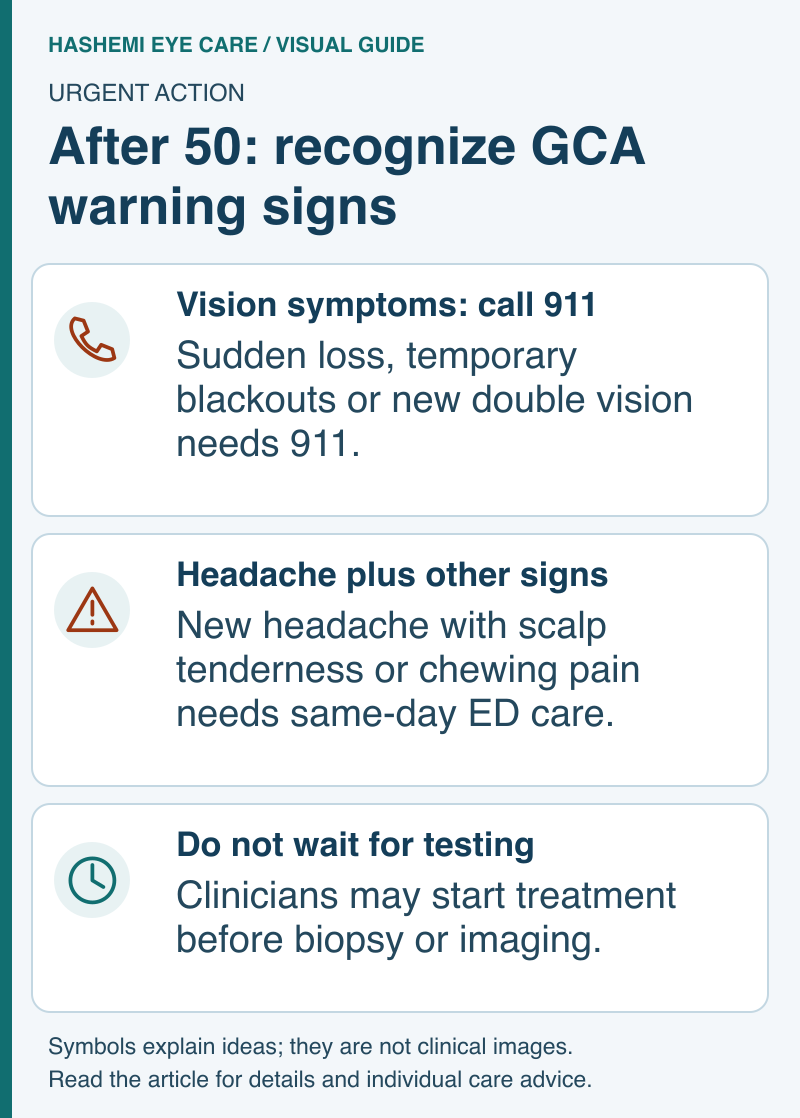
Visual guide: After 50: recognize GCA warning signs
Read this visual as text
What Is Giant Cell Arteritis?
Giant cell arteritis (GCA), also called temporal arteritis, is an inflammatory condition affecting the walls of arteries, particularly in the head and neck. When inflammation blocks blood flow to the eyes or optic nerves, sudden, permanent vision loss can occur.
GCA is a medical emergency because:
- Vision loss happens suddenly and is usually irreversible
- The second eye can be affected within days
- Treatment prevents blindness in the unaffected eye
Who Is at Risk?
GCA almost exclusively affects people over 50. Risk increases with:
- Age: Rare under 50, peak incidence in 70s and 80s
- Sex: Women are 2-3 times more likely than men
- Ethnicity: More common in people of Northern European descent
- History of polymyalgia rheumatica: Muscle pain and stiffness condition
Critical age marker: GCA is very uncommon under 50. If you're over 50, always consider GCA when you have a new headache and/or vision changes.
Warning Signs of GCA
The Classic Symptoms
New Headache
- Often in the temples (one or both sides)
- Different from any headache you've had before
- May be severe or just persistent and unusual
- Tender to touch over the temple arteries
Scalp Tenderness
- Pain when brushing or combing hair
- Tender when lying on a pillow
- Sensitivity over the temples
Jaw Claudication
- Jaw pain or fatigue when chewing
- Pain increases with prolonged chewing
- One of the most specific symptoms for GCA
- Different from TMJ (jaw joint) problems
Visual Symptoms
- Transient vision loss: episodes of vision going gray or black
- Sudden vision loss in one eye
- Double vision
- Dimming or blurring
Other Symptoms
- Fatigue and feeling unwell (malaise)
- Weight loss without trying
- Fever or night sweats
- Muscle aches, especially shoulders and hips (polymyalgia rheumatica)
- Tongue pain
How GCA Causes Vision Loss
Ischemic optic neuropathy is the most common cause of vision loss in GCA. Inflammation blocks the arteries supplying the optic nerve, cutting off blood flow. Without blood, nerve tissue dies rapidly.
Why timing matters:
- Once vision is lost, it rarely recovers significantly
- The other eye can be affected within days to 2 weeks
- Starting treatment immediately protects the remaining eye
What to Do If You Have Warning Signs
Call 911 immediately if you are over 50 and have sudden vision loss, temporary vision blackouts, new double vision, or stroke symptoms such as face droop, arm weakness, speech trouble, confusion, or trouble walking.
Go to the emergency department the same day if you are over 50 and have a new headache with any of these symptoms:
- Scalp tenderness
- Jaw pain when chewing
- Feeling generally unwell with no explanation
Do not wait for an appointment or to "see how it goes." Treatment may need to start before biopsy or imaging.
Where to Go
- Call 911: If you have sudden vision loss, transient blackouts, new double vision, or stroke symptoms
- Emergency department same day: For new headache plus scalp tenderness, jaw pain with chewing, unexplained fever/weight loss, or polymyalgia symptoms after age 50
- Call your eye doctor or primary doctor while going: They may help coordinate ESR/CRP testing, steroid treatment, temporal artery biopsy, and follow-up, but coordination should not delay emergency evaluation
What to Tell the Doctor
- Your exact age
- When symptoms started
- All symptoms, even if they seem unrelated
- Any recent vision changes, even if temporary
- Family history of GCA or polymyalgia rheumatica
Diagnosis of GCA
Blood Tests
Blood tests are an essential first step:
ESR (Erythrocyte Sedimentation Rate)
- Measures inflammation
- Usually very elevated in GCA (often >50-100)
- Not specific to GCA-can be elevated for other reasons
CRP (C-Reactive Protein)
- Another inflammation marker
- Often elevated along with ESR
- Together, ESR and CRP are very sensitive for GCA
Complete Blood Count
- May show anemia
- May show elevated platelets
Important: Normal blood tests don't completely rule out GCA. If clinical suspicion is high, treatment may still be started while awaiting further testing.
Temporal Artery Biopsy
Temporal artery biopsy can provide tissue confirmation when positive:
- A small piece of the temporal artery is removed
- Examined under microscope for inflammation
- Usually performed within days of starting treatment
- Treatment should NOT be delayed for biopsy
- Biopsy can remain positive for 2-6 weeks after starting steroids
Imaging
- Ultrasound of temporal arteries may show a "halo sign"
- CT or MRI may be used in some cases
- Depending on local expertise and the clinical picture, expert vascular ultrasound or other imaging may establish the diagnosis; some patients still need biopsy
Treatment: Why Steroids Are Essential
IV Steroids
For patients with vision loss or high-risk features:
- Methylprednisolone 1 gram IV daily for 3-5 days
- Urgently reduces inflammation
- May help salvage some vision if given very early
Oral Steroids
Prednisone is the cornerstone of treatment:
- High doses (40-60 mg or more) initially
- Symptoms often improve within days
- Very slow taper over 1-2 years
- Stopping too quickly risks relapse
Tocilizumab (Actemra)
A newer medication that can be added:
- Allows lower steroid doses
- Reduces relapse risk
- Given as injection or IV infusion
- FDA-approved for GCA
Why Treatment Is Long
- GCA requires months to years of treatment
- Tapering too fast causes relapse
- Relapses risk vision in the other eye
- Regular monitoring with blood tests (ESR, CRP) guides tapering
Protecting Your Vision
If You Haven't Lost Vision Yet
- Treatment prevents vision loss in most cases
- Take steroids exactly as prescribed
- Report any visual symptoms immediately
- Don't miss follow-up appointments
If You've Lost Vision in One Eye
- The priority is protecting the other eye
- High-dose steroids reduce risk to the fellow eye
- Vision loss in the affected eye is usually permanent
- Low vision resources can help with adaptation
Prompt treatment changes the risk: Many patients with GCA avoid significant vision loss when diagnosed and treated quickly. Even if one eye is affected, the other eye may still be protected.
Living with GCA Treatment
Long-term steroid treatment comes with challenges. See our Living with Steroid Treatment guide for detailed information on managing side effects.
Key Points
- Bone protection (calcium, vitamin D, sometimes bisphosphonates)
- Blood sugar monitoring
- Blood pressure monitoring
- Watch for infections
- Never stop steroids suddenly
Monitoring
During treatment, expect regular:
- Blood tests (ESR, CRP) to track inflammation
- Symptom assessment
- Watch for steroid side effects
- Adjustment of medication doses
Frequently Asked Questions
Can vision loss from GCA be reversed?
Unfortunately, vision loss from GCA is usually permanent. This is why prevention through early recognition and treatment is so critical. Rarely, patients treated extremely early may see some improvement.
Will I definitely lose vision if I have GCA?
No. Many patients diagnosed with GCA warning symptoms never lose vision because treatment was started in time. Vision loss is more likely when diagnosis or treatment is delayed, but it can sometimes occur early in the disease.
How long will I need to take steroids?
Treatment typically lasts 1-2 years, sometimes longer. The duration depends on how your body responds. Tocilizumab can help reduce steroid exposure.
What if my biopsy is negative?
A negative biopsy doesn't completely rule out GCA because inflammation can be patchy in the artery. If clinical suspicion remains high, treatment may continue. Your doctor will make this judgment based on your full clinical picture.
Can GCA come back after treatment stops?
Yes, relapse is possible, usually within the first 2 years. This is why tapering is slow and monitoring continues. Symptoms like headache or elevated inflammatory markers may signal relapse.
Is GCA hereditary?
There's some familial tendency, but GCA isn't directly inherited. Having a family member with GCA or polymyalgia rheumatica may slightly increase your risk.
Can I take aspirin for GCA?
Do not start aspirin yourself. ACR guidance supports considering it for critical or flow-limiting vertebral/carotid artery disease; other cardiovascular indications and bleeding risk also matter. Aspirin does not treat the vessel inflammation or replace urgent glucocorticoids.
What happens if I miss my steroid dose?
Follow the missed-dose instructions on your prescription or ask your pharmacist/prescriber; do not double doses unless specifically directed. Contact the team promptly if vomiting or supply problems prevent taking treatment. New visual symptoms require emergency care even after treatment has started.
When to Seek Emergency Care
Call 911 immediately if you experience:
- Sudden vision loss in either eye
- Return of visual symptoms after starting treatment
- Severe sudden headache
- Symptoms suggesting stroke (weakness, speech difficulty)
Go to the emergency department the same day for new GCA symptoms without those 911 features, especially jaw claudication or scalp tenderness.
GCA is an emergency-time is vision.
Summary: The Key Message
If you're over 50 and experience:
- New headache (especially at temples)
- Scalp tenderness
- Jaw pain when chewing
- Visual disturbances
Call 911 for sudden vision loss, temporary blackouts, or new double vision. Seek same-day emergency assessment for the other warning signs. These symptoms may indicate GCA; prompt treatment can protect remaining vision. Do not wait to see whether symptoms improve.
References
-
ACR/Vasculitis Foundation. 2021 GCA management guideline.
-
Hellmich B, et al. 2018 Update of the EULAR recommendations for the management of large vessel vasculitis. Ann Rheum Dis. 2020.
-
Maz M, et al. 2021 American College of Rheumatology/Vasculitis Foundation guideline for the management of giant cell arteritis and Takayasu arteritis. Arthritis Rheumatol. 2021;73(8):1349-1365.
-
Hayreh SS. Ischemic optic neuropathies. Prog Retin Eye Res. 2009.
-
American College of Rheumatology. Giant Cell Arteritis.
-
Vasculitis Foundation. Giant Cell Arteritis.
Medical Disclaimer: This information is for educational purposes only and does not replace professional medical advice, diagnosis, or treatment. GCA is a medical emergency; if you suspect you have symptoms of GCA, seek immediate medical care.