
Strabismus Surgery
Adult Strabismus Surgery in Los Angeles
Adult eye-muscle surgery for persistent double vision, long-standing misalignment, and selected stable nerve palsies at our Encino office, with a separate pediatric pathway for children and families.
Is It Time?
Who strabismus surgery helps
Eye misalignment affects children and adults, and adult cases can often be treated.
- Double vision from a cranial nerve palsy that has been stable for 6+ months
- Misalignment from thyroid eye disease, once the disease is quiet
- Childhood strabismus that has returned or worsened in adulthood
- A constant head turn or tilt used to control double vision
- Eye misalignment affecting confidence, work, or social life
- Children with crossing or drifting eyes not controlled by glasses or patching
New double vision in an adult is different: it needs prompt medical evaluation to find the cause, sometimes urgently. Because our surgeons are neuro-ophthalmologists, the cause-finding workup and the surgical repair happen under one roof.
Our Approach
Adult eye misalignment is treatable: it is not too late
Many adults were told decades ago that nothing could be done about their eye alignment, or that surgery would be “purely cosmetic.” Adults of many ages can benefit from treatment. Surgery aims to improve alignment and, when possible, reduce double vision. Adjustable sutures allow early fine-tuning in selected patients; the choice of technique depends on the pattern of misalignment and the surgical plan.
The order of operations matters: before any muscle is moved, the cause has to be understood. Nerve palsies, thyroid eye disease, and myasthenia gravis each behave differently, and operating before the measurements are stable is how poor results happen. Dr. Ghiam’s neuro-ophthalmology training means the diagnosis and the surgical plan come from the same discipline.
One honest expectation to set early: strabismus surgery corrects alignment, not focus. If you needed glasses before surgery, you will likely still need them. Surgery may reduce the need for prisms, but some patients continue to use them for residual double vision.
For Children and Parents
A clearly separate pediatric evaluation path
Children are assessed around visual development, amblyopia risk, age, and prior glasses or patching—not through the adult double-vision pathway.
- Bring prior eye records, glasses prescriptions, patching history, and any earlier surgery details.
- The visit considers alignment, visual development, and whether nonsurgical care has been fully tried.
- When surgery is appropriate, the office explains anesthesia, recovery, and school or activity planning directly with parents and caregivers.
What to Expect
From evaluation to stable alignment
- Consultation
Measurements that drive the plan
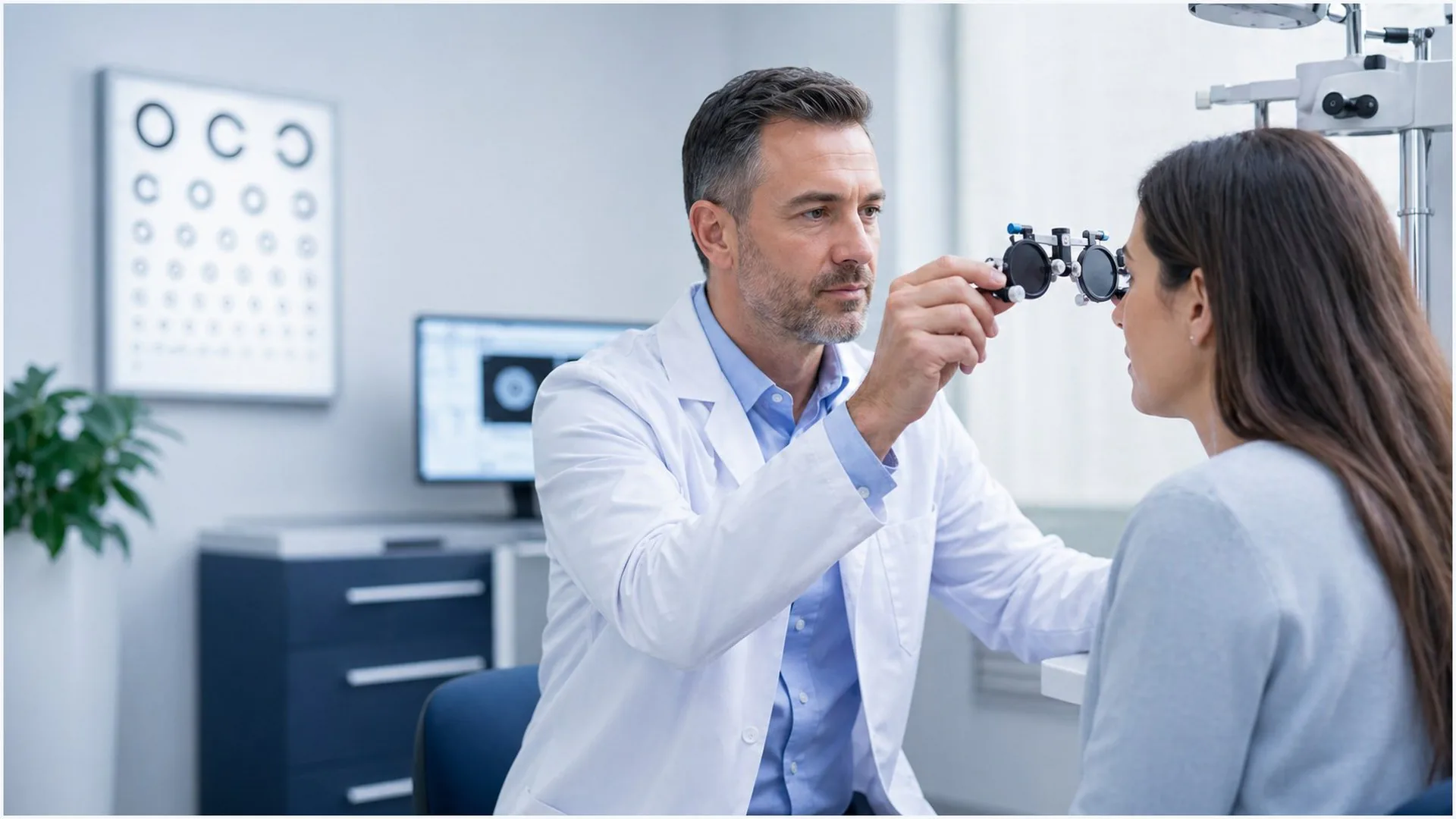
A full sensorimotor examination with prism measurements, often repeated across visits, because operating on stable, confirmed numbers is what makes results predictable.
- Planning
Which muscles, and how much
Overacting muscles are weakened (recession), underacting muscles strengthened (resection). In selected adults, adjustable sutures allow the alignment to be fine-tuned after surgery.
- Day of surgery
30–60 minutes per eye, outpatient
Children are asleep under general anesthesia; selected adults may choose local anesthesia with sedation. The surgery happens on the surface muscles, with no incision into the eye itself, and you go home the same day.
- First days
Red, scratchy, and normal
Redness and soreness for one to two weeks is expected. You'll use antibiotic and steroid drops and avoid swimming and dusty environments while the surface heals.
- Weeks 1–2
Back to daily life
Most patients return to office work within one to two weeks. Contact sports wait two to four weeks.
- Follow-up
Checking alignment and double vision
Your surgeon measures alignment and asks about double vision as healing progresses. Eye position can change during recovery or later. Residual misalignment may be managed with prisms or further surgery, depending on your symptoms and measurements.
Outcomes
What surgery can achieve
The AAO review of adult strabismus surgery describes improvements in alignment and visual function across studies with different patient groups. A study’s alignment result does not tell us whether every patient saw a single image or needed further surgery.
These are treatment goals, not Hashemi Eye Care outcome rates. Your outlook depends on the underlying cause, prior treatment, and how your eyes work together. Dr. Ghiam will discuss the expected benefits and limitations for your case.
Insurance & Cost
Functional surgery, medical insurance
Strabismus surgery is generally performed for functional reasons such as double vision, an abnormal head posture, or loss of binocular vision, and is handled through medical insurance rather than vision plans. Coverage details differ by plan and indication, so contact our office before scheduling and our staff will help you verify your benefits.
When realignment is sought for appearance alone, coverage varies between insurers. We will tell you honestly which category your case falls into at the consultation, before anything is scheduled.
Common Questions
Strabismus surgery questions, answered
Am I too old for strabismus surgery?
Age alone does not rule out treatment. Long-standing misalignment from childhood can still be evaluated in adulthood. Your health, measurements, symptoms, and treatment goals determine whether surgery is appropriate.
Will I be awake during surgery?
Children have general anesthesia. Adults can choose general anesthesia or, in selected cases, local anesthesia with sedation, which also allows adjustable sutures to be fine-tuned.
How painful is the recovery?
Eyes are typically sore, red, and scratchy for one to two weeks: uncomfortable rather than severely painful, and manageable with over-the-counter pain relief.
Will surgery fix my double vision?
Surgery aims to reduce double vision, especially when looking straight ahead, but improved eye alignment does not guarantee single vision. Double vision can persist or appear after surgery. The likely benefit depends on the cause, your ability to use both eyes together, and prior treatment. Dr. Ghiam will discuss your individual outlook and whether prisms or further treatment may be needed.
What are the risks of strabismus surgery?
The eyes may remain misaligned, and double vision can persist or develop after surgery. Further treatment may be needed. Less common complications include infection, bleeding, scarring, and reactions to anesthesia; vision loss is rare. Your surgeon will discuss the risks that apply to your health and surgical plan.
Will I still need glasses?
You may still need your usual glasses because alignment surgery does not change the eye's focusing power. Surgery may reduce your need for prism correction, but prisms can still help if double vision remains.
What if the first surgery isn't perfect?
If misalignment or double vision remains, your surgeon will reassess the measurements and discuss options such as prisms or another operation. Some operations are planned in stages; others address a residual or recurrent eye turn. An early adjustable-suture adjustment is different from another operation. The need for further surgery depends on the cause, prior surgery, and changes over time.
Learn More
Read deeper in our education library
The medical facts on this page are drawn from our physician-reviewed patient education library.
Your Encino Visit
Directions and office details
Hashemi Eye Care is at 16542 Ventura Blvd #515, Encino, CA 91436. Office hours are Monday-Friday, 8am-5pm.
Serving patients in Encino, Los Angeles, Sherman Oaks, Tarzana, Calabasas, Woodland Hills, Studio City, Burbank, Glendale, Pasadena, and the greater San Fernando Valley.
Open directions (opens in new tab) or review parking and access details before your visit.
Next Step
Get a straight answer about your eye alignment.
Request a consultation with Dr. Ghiam at our Encino office. We see adults and children from Sherman Oaks, Tarzana, Woodland Hills, and across the greater Los Angeles area.