

Double Vision (Diplopia)
Seeing two images of a single object can be alarming. Learn what causes double vision, when it's serious, and what to expect at your appointment.
Double vision can appear as a shadow-like second image or as two fully separate images. Doctors call double vision diplopia; if that word appears on your visit summary, this page covers the same symptom. It can interfere with reading, walking, depth perception, and driving. Cover each eye separately and notice whether the doubling remains when each eye views by itself. That distinction helps a clinician separate monocular from binocular diplopia.
Key takeaways
- Cover each eye separately: binocular diplopia disappears with either eye covered; monocular diplopia remains when the affected eye views by itself
- Sudden double vision requires prompt evaluation, especially when it is new in adulthood
- Headache, droopy eyelid, weakness, slurred speech, or a dilated pupil make it urgent
- Many cases can be treated or at least controlled once the cause is identified
New or sudden double vision needs prompt medical assessment. For persistent or unexplained symptoms, a neuro-ophthalmology evaluation can identify the cause and next step.
Not sure what kind of double vision you have? Try our 3-question diplopia picker - it helps you recognize common double-vision patterns to discuss with a clinician based on whether the doubling goes away with one eye covered, the direction of the offset, and whether tilting your head helps.
What Does Double Vision Look Like?
Double vision means one object appears twice. The second image may be clear, faint, transparent, shadow-like, or tilted. The images may overlap slightly or separate enough to look like two distinct objects.
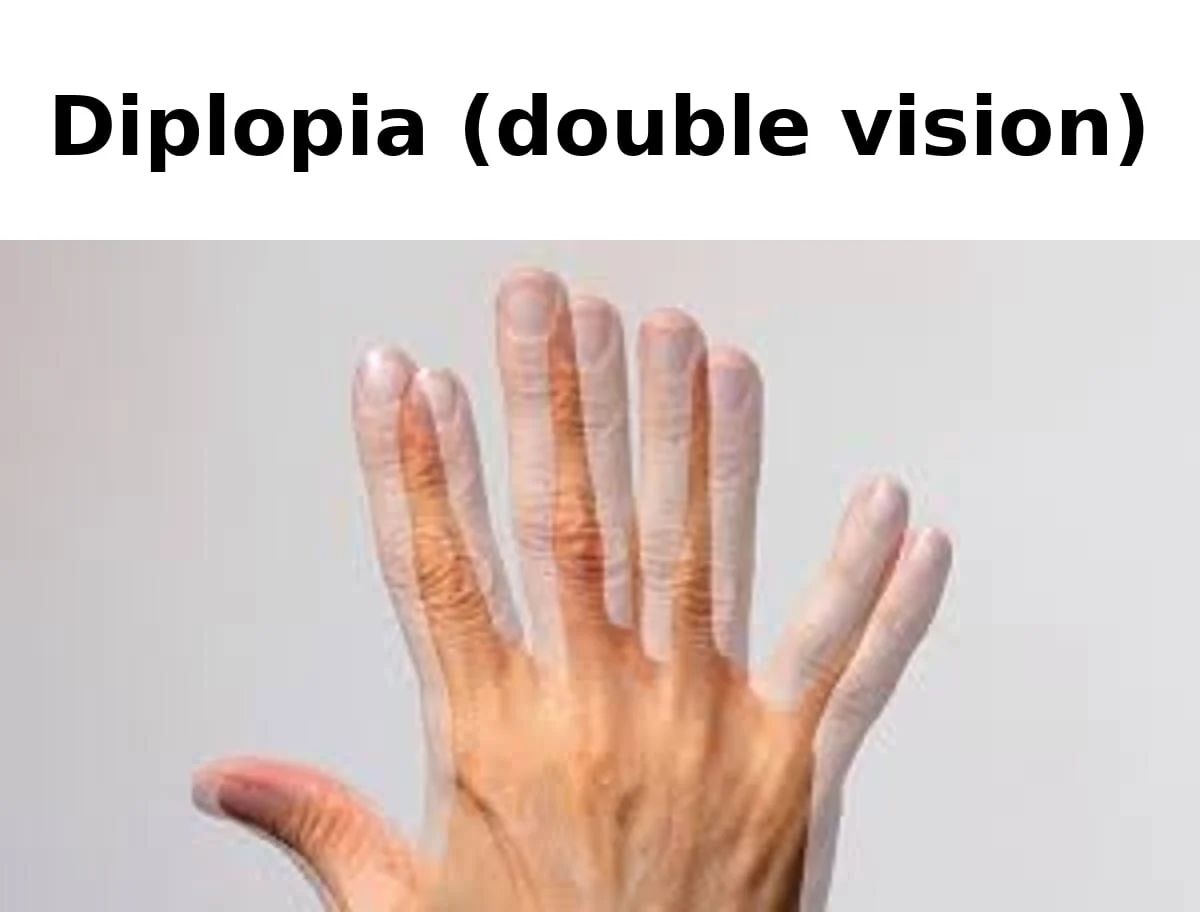
People describe double vision in different ways, and those details help identify the cause:
- Seeing two separate images side-by-side (horizontal diplopia)
- Seeing one image above the other (vertical diplopia)
- Images appearing tilted or at an angle to each other
- Ghost images or shadows around objects
- Difficulty reading because letters seem to overlap
- Trouble judging distances or depth
- Closing one eye to see clearly
- Tilting or turning your head to reduce the double image
- Worsening symptoms when tired or at the end of the day
- Double vision that comes and goes throughout the day
- Feeling dizzy or off-balance because of the visual confusion
- Difficulty driving, especially at night
- Eye strain or headache from trying to focus
Horizontal, Vertical, and Oblique Double Vision
The direction of separation gives the examiner a localization clue. It does not identify the cause by itself.
| Pattern | What it looks like | Conditions clinicians may consider |
|---|---|---|
| Horizontal diplopia | Images sit side by side | Sixth nerve palsy, third nerve palsy, convergence problems, myasthenia gravis, or eye muscle restriction |
| Vertical diplopia | One image appears above the other | Fourth nerve palsy, third nerve palsy, skew deviation, thyroid eye disease, or myasthenia gravis |
| Oblique or torsional diplopia | Images are diagonal or one appears tilted | Fourth nerve palsy, skew deviation, orbital disease, trauma, or other eye movement disorders |
Horizontal double vision that worsens at distance or when looking toward one side can fit a sixth nerve palsy. Vertical double vision that changes with head tilt or looking down can fit a fourth nerve palsy. A neuro-ophthalmic exam is needed because several conditions can produce the same pattern.
What Causes Diplopia?
The cause depends first on whether the double image remains in one eye or disappears when either eye is covered.
Double Vision in One Eye (Monocular Diplopia)
Monocular diplopia means the extra image remains when the affected eye is open by itself. It disappears when that affected eye is covered. Test each eye separately because covering only one eye can give a misleading result.
Common causes include:
- Uncorrected astigmatism or a glasses prescription that needs updating
- Dry eye or an irregular tear film
- Cataracts or another lens problem
- Corneal irregularity, scarring, or keratoconus
- Less commonly, a retinal problem or a neurologic cause
Ghosting that changes after blinking often points toward the tear film. Monocular diplopia still deserves an eye exam, especially when it is new, persistent, painful, or accompanied by reduced vision, flashes, floaters, or a curtain-like shadow.
Binocular Double Vision (Binocular Diplopia)
Binocular diplopia disappears whenever either eye is covered. It occurs when the eyes are misaligned or cannot move together normally. Causes include:
Eye muscle or nerve problems:
- Sixth cranial nerve palsy (abducens nerve): difficulty looking outward
- Fourth cranial nerve palsy (trochlear nerve): vertical misalignment, often with head tilt
- Third cranial nerve palsy (oculomotor nerve): may include droopy eyelid and dilated pupil
- Myasthenia gravis: muscle weakness that worsens with use
- Thyroid eye disease: swelling of eye muscles from Graves' disease
Other causes:
- Stroke or brain injury affecting eye movement centers
- Diabetes or high blood pressure affecting small blood vessels to eye nerves
- Head trauma or concussion
- Multiple sclerosis
- Brain tumors or aneurysms (rare but serious)
Sudden Double Vision That Goes Away
Sudden temporary double vision can be a warning sign of a transient ischemic attack (TIA) or stroke, particularly when it is binocular. TIA symptoms often last less than an hour and can resolve completely. A first episode of sudden temporary binocular double vision in an adult needs urgent same-day medical assessment even after normal vision returns.
Call 911 if the episode is happening now or occurs with any BE-FAST stroke sign: new Balance trouble, Eye or vision change, Facial droop, Arm weakness, or Speech difficulty. Also call 911 for fainting, confusion, severe sudden headache, or difficulty walking. Note the time the symptoms began and avoid driving yourself.
Brief ghosting in one eye that clears with blinking can come from dry eye. A first sudden episode still requires an evaluation before the cause can be determined safely.
When Double Vision Is an Emergency
Call 911 immediately if double vision is sudden and occurs with any of these:
- Sudden severe headache (worst headache of your life)
- Drooping eyelid, especially with dilated pupil on the same side
- Weakness or numbness in the face, arm, or leg
- Slurred speech or difficulty speaking
- Difficulty swallowing
- Loss of balance or coordination
- Recent head injury
A painful red or bulging eye with double vision also needs same-day emergency department evaluation. These symptoms may indicate a stroke, brain aneurysm, orbital infection, or other neurological emergency.
What You'll Be Asked in Clinic
Expect very specific questions. They may feel repetitive, but each one helps localize the problem:
About the symptoms:
- When did the double vision start-suddenly or gradually?
- Is it constant or does it come and go?
- Does it affect one eye or both? (They'll have you cover each eye to check)
- Are the images side-by-side, one above the other, or tilted?
- Is it worse in certain directions of gaze?
- Does it worsen as the day goes on or with fatigue?
About your health:
- Do you have diabetes, high blood pressure, or thyroid disease?
- Have you had any recent head injuries?
- Do you have weakness elsewhere (arms, legs, chewing, swallowing)?
- Any recent infections or illnesses?
- What medications are you taking?
- Family history of neurological conditions?
How Double Vision Is Diagnosed
Eye Examination
- Visual acuity testing: reading the eye chart with each eye
- Cover/uncover test: checking eye alignment
- Eye movement assessment: following a target in all directions
- Pupil examination: checking for size differences and reactions
- Slit-lamp exam: examining the front of the eye
- Dilated fundus exam: viewing the optic nerve and retina
Additional Tests
Depending on findings, you may need:
- Optical coherence tomography (OCT): detailed scan of the retina and optic nerve
- Visual field testing: mapping your peripheral vision
- MRI of the brain and orbits: imaging to look for tumors, aneurysms, stroke, or inflammation
- Blood tests: checking for diabetes, thyroid dysfunction, myasthenia gravis antibodies, or inflammatory markers
- Ice pack test: a simple bedside test for myasthenia gravis (cold improves muscle function)
Double Vision (Diplopia) Treatment
Treatment depends entirely on why the images are separating:
Binocular Diplopia Treatment
Treatment begins with the cause. A stroke, aneurysm, infection, inflammation, myasthenia gravis, thyroid eye disease, or cranial nerve palsy each requires a different plan. These options may control the double image while the cause is treated or recovery occurs:
- Patching one eye: can suppress binocular double vision while workup continues
- Fresnel prisms: temporary stick-on prisms for glasses to align images
- Prism glasses: permanent prisms for a smaller, stable misalignment
- Head positioning: turning or tilting the head to minimize diplopia
- Botulinum toxin injections: used selectively to weaken an overacting muscle
- Strabismus surgery: may realign the eyes when the deviation is stable
Monocular Diplopia Treatment
Treatment targets the optical problem in the affected eye:
- New glasses or contact lens prescription: for astigmatism or another refractive error
- Treatment of dry eye: artificial tears, punctal plugs, or other therapies
- Cataract surgery: if cataracts are causing the problem
- Corneal treatment: specialty lenses or treatment of corneal disease when the surface is irregular
Treating Neurologic and Systemic Causes
- Blood sugar and blood pressure control: for microvascular cranial nerve palsies
- Steroids or other immune therapies: for inflammatory conditions
- Medications for myasthenia gravis: pyridostigmine and immunosuppressants
- Thyroid disease management: medication, radiation, or surgery for Graves' disease
For Serious Causes
- Emergency treatment for stroke
- Neurosurgical intervention for aneurysms or tumors
- Ongoing neurological care for conditions like multiple sclerosis
Patient Guide: Living with Double Vision
For more detail about diagnosis, daily adaptations, prisms, patching, and recovery timelines, see Navigating Double Vision.
What to Expect Going Forward
Many causes of double vision improve or resolve:
- Microvascular cranial nerve palsies (from diabetes or high blood pressure) often improve on their own over 2-3 months
- Post-concussion diplopia typically improves with time and may benefit from vision therapy
- Myasthenia gravis can usually be well-controlled with medication
- Thyroid eye disease often stabilizes and may be treated surgically once stable
Your neuro-ophthalmologist will monitor your progress and adjust treatment as needed. Follow-up appointments are important to track improvement and catch any changes.
Frequently Asked Questions
Is double vision always serious?
Not always. A new glasses prescription, dry eye, cataract, or fatigue-related eye alignment problem can cause it. But sudden double vision, especially with other symptoms, should be evaluated promptly.
Can stress cause double vision?
Stress and fatigue can worsen existing eye alignment problems or cause intermittent double vision in susceptible individuals. If you notice double vision during stressful periods, it's still worth having an evaluation to rule out underlying causes.
Will my double vision go away on its own?
It depends on the cause. Some types, like those from small blood vessel problems in diabetes, often improve within weeks to months. Others may need treatment. Only a proper evaluation can determine your likely course.
Can I still drive with double vision?
Driving with active double vision is unsafe and may violate licensing rules. Avoid driving until the diplopia is resolved, adequately corrected, or your clinician has cleared you to drive. Discuss driving restrictions with your doctor.
Why does my double vision get worse at night?
Dim lighting makes the pupils dilate, which can unmask or worsen certain types of double vision. Additionally, eye muscle fatigue accumulates throughout the day, making symptoms worse by evening.
Is double vision a sign of a stroke?
It can be. Double vision that starts suddenly, especially with facial drooping, arm weakness, speech difficulty, balance trouble, confusion, or severe headache, could indicate a stroke. Call 911 immediately.
What does ICD-10-CM code H53.2 mean?
H53.2 is the ICD-10-CM code for diplopia, or double vision. The code records the symptom only. Clinicians document whether it is monocular or binocular, its cause, and its urgency separately.
How long will the workup take?
An initial neuro-ophthalmology evaluation typically takes 1-2 hours. If imaging or blood work is needed, results may take additional days. Your doctor will explain the timeline based on your specific situation.
Can children get double vision?
Yes. In children, double vision may indicate strabismus (eye misalignment) or other conditions. Children may suppress one image and never report double vision, so eye alignment problems can sometimes be missed. Regular pediatric eye exams are important.
References
- American Academy of Ophthalmology. Diplopia (Double Vision).
- North American Neuro-Ophthalmology Society. Double Vision.
- National Eye Institute. Convergence Insufficiency.
- American Academy of Ophthalmology EyeWiki. Basic Approach to Diplopia.
- American Stroke Association. B.E. F.A.S.T. Eye and Vision Changes.
- Brazis PW, Masdeu JC, Biller J. Localization in Clinical Neurology. 7th ed. Wolters Kluwer; 2016.
Medical Disclaimer: This information is for educational purposes only and does not replace professional medical advice, diagnosis, or treatment. If you have concerns about double vision or any symptoms, please consult a qualified healthcare provider.